
Fertilizer caking is the most common complaint during storage. However, many people are unaware that the root causes of caking in BB (bulk-blended) fertilizers and organic fertilizers stem from completely different stages of the production process. Applying the same anti-caking strategy to both often addresses only the symptoms rather than the underlying cause.
For BB fertilizers, moisture absorption is the trigger, while segregation is the driving force. BB fertilizers are produced using finished granular raw materials—such as urea, ammonium phosphate, and potassium chloride. Among these, urea is the most hygroscopic, with a critical relative humidity of approximately 70%. When warehouse humidity is high, the surface of the urea granules absorbs moisture and dissolves; as it subsequently dries, it recrystallizes, forming “bridges” between the granules that bind loose material into hard lumps. While moisture absorption acts as the trigger, the primary driver is segregation. If the batching system (e.g., a multi-silo, single-weigh static batching system) lacks sufficient precision, or if the mixing process is inadequate, the various nutrient granules will not be distributed uniformly within the packaging. Areas with a higher local concentration of urea are more prone to moisture absorption, meaning caking begins at these “vulnerable points.” Therefore, preventing caking in BB fertilizers requires more than just adding anti-caking agents; it necessitates controlling the consistency of raw material particle sizes, improving batching accuracy, and minimizing the time the material spends in storage after mixing.
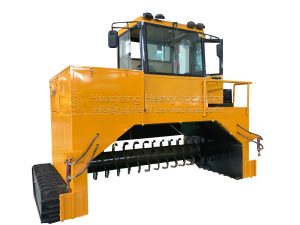
For organic fertilizers, the root cause is uneven fermentation, with moisture acting as a contributing factor. The caking mechanism here is entirely different from that of BB fertilizers. Organic fertilizers are derived from fermented, decomposed organic matter. If a windrow compost turner does not reach a sufficient depth or moves too quickly, the degree of decomposition and moisture content will vary across different parts of the compost pile. Areas that have not fermented thoroughly contain residual, undecomposed organic matter; during storage, this material continues to ferment slowly, generating heat and causing the surfaces of the granules to become sticky. In areas with high moisture content, moisture migration occurs after packaging, leading to the adhesion of granules. Even when using large-scale compost-turning equipment capable of reaching greater depths, if the material does not remain in the fermentation bay for an adequate duration, it can result in a product that is “decomposed on the outside but raw on the inside.” Regardless of the specific model, the uniformity achieved by a compost turner—a general term for such equipment—directly determines the stability of subsequent granulation and storage processes. If organic fertilizer is not thoroughly dried after granulation—leaving a moisture content above 15%—the risk of caking increases exponentially.
Consequently, the strategies for preventing caking differ between the two types of production lines. For BB (bulk blend) fertilizer, the focus must be on controlling humidity, preventing ingredient segregation, and managing the residence time after mixing. For organic fertilizer, the focus must be on ensuring uniform fermentation, controlling the depth of the compost turning process, and achieving the target final moisture content after drying. Applying moisture-proof packaging solutions designed for BB fertilizer to organic fertilizer will not resolve internal heat generation caused by uneven fermentation; conversely, extending the fermentation period—a strategy for organic fertilizer—will not prevent urea from absorbing moisture. It is far more effective to first determine whether the caking is caused by “physical moisture absorption” or “biological heat generation,” and then decide whether to adjust the formulation, the turning process, or the drying stage, rather than simply resorting to the indiscriminate addition of anti-caking agents.