
In an organic fertilizer disc granulation production line, operators often focus on parameters like rotational speed, disc inclination, and water spray volume, while overlooking a more fundamental issue: the sequence of starting up and shutting down the equipment. If the sequence is incorrect, even the best operating parameters will fail to produce high-quality granules.
Disc Granulator: Start empty, then feed. If material is allowed to accumulate on the disc of an organic fertilizer granulator while it is stationary, the motor must overcome the static friction between the material and the disc surface upon start-up. This causes an instantaneous surge in electrical current, which can trigger a circuit breaker trip, or in more severe cases, burn out the motor or shear the drive shaft. The correct start-up sequence is: start the granulator while it is empty, ensure the disc is rotating smoothly, then start the mixer and the feeder, and finally, turn on the water spray. The shutdown sequence is the reverse: stop the feed and water spray first, allow the remaining material on the disc to continue rolling for a few minutes until the granules have been largely discharged, and then stop the granulator. If the granulator is stopped abruptly while wet material remains on the disc, the material will dry into a hard crust; this creates an uneven surface for the next start-up, leading to inconsistent granule sizes.
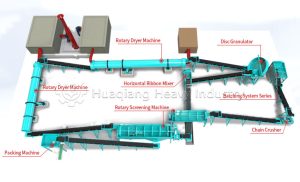
Disc Granulation Production Line: Start auxiliary conveying equipment before the main unit. In a disc granulation production line, the screening machine, return-material conveyor belts, and dust collection system should be started before the granulator. This ensures that when the granulator begins discharging, the screening and return-material systems are already operational, preventing material from piling up on the screens or overloading the return conveyor belts. The shutdown process is the opposite: after the granulator is stopped, the conveying and screening equipment should continue to run for a few minutes to clear out any residual material, preventing it from caking inside the machinery.
Modern “Two-in-One” Granulator: The mixing zone must be started before the granulation zone. Modern “two-in-one” organic fertilizer granulators integrate both the mixing and granulation processes into a single main unit. If the granulation zone is started before the mixing zone, unmixed material will fall directly into the granulation zone, leading to uneven nutrient distribution and inconsistent granule strength. The correct startup sequence is: start the mixing zone first, wait for it to reach a stable operating state, then start the granulation zone, and finally begin feeding the material. When shutting down, stop the feed first, allow the mixing and granulation zones to continue running for a few minutes to clear out any remaining material, and then shut down the units in sequence.
For bio-organic fertilizer granulation, post-shutdown cleaning is even more critical than the startup process. Bio-organic fertilizer production demands high standards of hygiene; if moist material is left on the granulation disc, mixing shafts, or within conveying pipes, it can easily foster the growth of unwanted microorganisms, which may contaminate the functional microbial agents in the next production batch. Therefore, after shutdown, all components that have come into contact with the material must be thoroughly cleaned using clean water or a disinfectant, followed by ventilation and drying. Modern organic fertilizer granulators should be designed for quick disassembly and cleaning, with hoppers and discharge outlets free of “dead zones” where material could accumulate.
The startup sequence is not merely a matter of “pressing a button.” It directly influences the lifespan of the motors, the uniformity of the granules, and the hygienic safety between production batches. Establishing a fixed startup sequence as a formal operating procedure is far more effective than repeatedly adjusting rotational speeds.