
Bulk Blended Fertilizer (BB Fertilizer): Spherical granules offer good flowability but are prone to segregation. NPK blending lines process finished granules such as urea, ammonium phosphate, and potassium chloride. These materials typically leave the factory in spherical or near-spherical shapes, characterized by low angles of repose and excellent flowability. NPK blending machines utilize gentle, twin-shaft paddle mixing—completing the process in 2–5 minutes with a coefficient of variation (CV) for uniformity of ≤5% and a granule breakage rate controlled below 0.5%. However, the hidden risk with spherical granules lies not in flow, but in stratification: urea is light while potash is heavy; if particle sizes differ, the materials will spontaneously separate during conveying and packaging. Consequently, the anti-segregation design of blending lines focuses on matching raw material particle sizes and controlling drop heights during conveying.
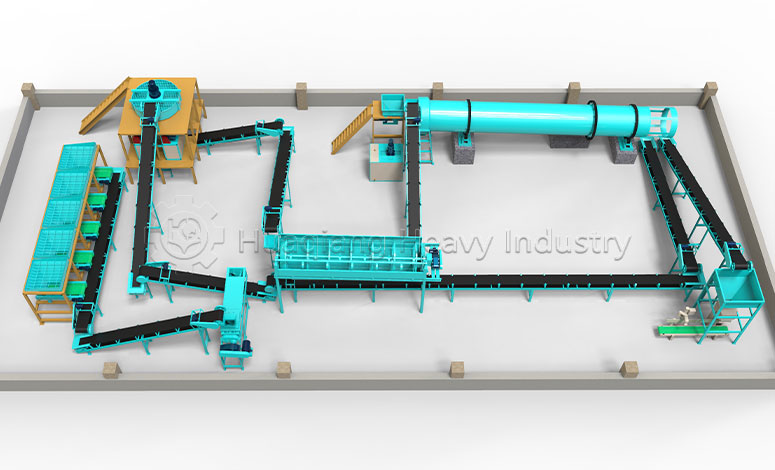
Double-Roller Extrusion: Cylindrical granules offer high strength but poor flowability. Double-roller press granulators compress powdered material into dense sheets under high pressure, followed by crushing and screening. The resulting granules are typically cylindrical or irregularly flake-shaped with distinct edges; they exhibit strong inter-particle friction and mechanical interlocking, resulting in an angle of repose significantly larger than that of spherical granules. In roller press granulator production lines, if the finished product discharges directly into deep-cone bins, it easily forms stable arches, causing flow interruptions. While the production technology allows for an optional downstream rounding process—trimming cylindrical granules into near-spherical shapes to improve flowability—this increases both equipment investment and operating costs. Bio-organic fertilizer features good sphericity, yet its moisture content varies. Machines producing this type of fertilizer utilize wet agglomeration granulation, resulting in granules with high sphericity and—under normal conditions—better flowability than extruded granules. However, if drying is insufficient post-granulation and the moisture content exceeds 15%, the increased stickiness of the organic matter causes the granules to adhere to one another, leading to issues such as bridging or material blockages. Consequently, the design of storage hoppers for bio-organic fertilizer must account for both granule shape and fluctuations in moisture content.