
When selecting granulation equipment, many fertilizer plants habitually focus solely on the figures in the price quote. A disc granulator might be listed at 30,000 to 50,000 yuan, while a roller press granulator is quoted at 100,000 to 200,000 yuan; intuitively, the latter seems much more expensive. However, the true determinant of return on investment is never the price of the individual machine, but the total cost of ownership across the entire process chain associated with the equipment. The disc granulator, the roller press, and the newer “two-in-one” granulator represent three vastly different cost structures; calculating these figures accurately before proceeding is far more cost-effective than attempting to remedy the situation later.
The first factor is the initial investment cost. While the disc granulator has a simple structure and a low price tag, its wet granulation process necessitates auxiliary equipment such as a dryer, a cooler, and a hot-blast stove. For a plant with an annual capacity of 50,000 tons, the total investment for a complete disc granulation production line ranges from approximately 2 million to 3 million yuan. In contrast, roller press granulation utilizes a dry process where powdered material is compressed directly into granules by high-pressure rollers at ambient temperature, eliminating the need for drying and cooling systems. For the same production scale, the total investment is approximately 1.5 million to 2.2 million yuan—15% to 25% lower than that of a disc granulation line. Crucially, omitting drying equipment allows the factory’s infrastructure footprint to be reduced by about 30%; this “hidden cost” does not appear on the price quote but represents a significant portion of the total budget.
The second factor is operational energy consumption, which is where the long-term cost gap truly widens. Granules produced via the disc method have a moisture content of 8% to 12% and must be dried using hot air to below 3% before packaging and storage. The coal cost alone for drying one ton of finished product ranges from 50 to 70 yuan; when combined with the electricity consumed by induced-draft fans and rotary drums, the expenses associated with the drying stage are substantial. Twin-roll extrusion bypasses this stage entirely; the combined electricity consumption is approximately 25–35 kWh per tonne, translating to an energy cost of just 20–28 yuan per tonne based on industrial electricity rates. The disc granulation process requires binders like bentonite—adding 30–50 yuan per tonne in auxiliary material costs—whereas twin-roll extrusion requires no binders. Combining these three factors, the operating cost per tonne of finished product for a twin-roll extrusion line is 60–80 yuan lower than that of a disc granulation line.
The third calculation concerns the product price premium, where the advantage shifts in the opposite direction. Disc granulation produces uniform, spherical granules with smooth surfaces; in the retail market, this aesthetic appeal can command a price premium of 50–100 yuan per tonne, as farmers and gardening enthusiasts are willing to pay for superior visual quality. In contrast, twin-roll extruded granules feature indentations and irregular shapes. While appearance is not a barrier for bulk agricultural wholesale, the superior sphericity of disc-granulated products becomes a significant factor when targeting high-end gardening or home potted-plant markets.
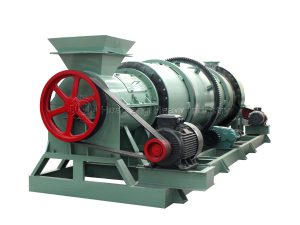
As for the “new type two-in-one organic fertilizer granulator,” its value lies in its integrated design, which streamlines the equipment chain. By combining mixing and granulation into a single machine, it eliminates intermediate material transfer steps. For small-to-medium organic fertilizer plants facing space constraints or significant fluctuations in raw material moisture content, this approach strikes a pragmatic balance between initial investment and operational simplicity. When all three factors are weighed, the conclusion is straightforward: disc granulation lines are ideal for operations seeking retail price premiums and possessing the necessary drying infrastructure; conversely, for operations prioritizing return on investment and utilizing primarily dry powder or high-fiber raw materials, the cost advantages of twin-roll extrusion become apparent within the first year of production. Ultimately, the key to selecting the right equipment lies not in comparing price quotes, but in accurately calculating the hidden costs inherent in each production process before making a decision.