
In major palm oil producing regions such as Malaysia and Indonesia, a large amount of empty palm fruit bunches (EFB) are generated annually. These fibrous wastes have a high moisture content (up to 70%) and contain hard lignin, resulting in extremely slow natural decomposition. Converting them into organic fertilizer not only alleviates environmental pressures but also creates export value. This article provides an equipment solution for EFB, from crushing and fermentation to finished product, tailored to its characteristics.
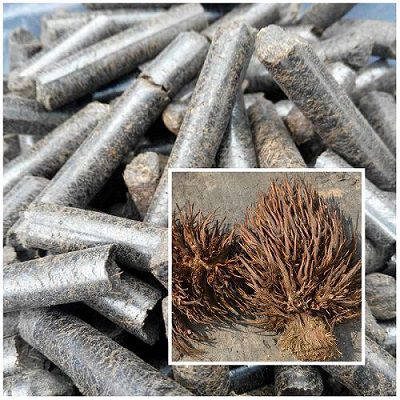
EFB Crushing Challenges: Specialized Blades and Pretreatment
EFB is characterized by long fibers, high toughness, and high moisture content, making it prone to tangling and clogging in ordinary straw crushers. Heavy-duty single-shaft shredders or dual-shaft shear crushers are essential.
Equipment Selection: A dual-shaft low-speed shredder is recommended, with a speed of 20-40 rpm. The blades are made of hard alloy weld overlay (hardness HRC55-60), and the cutter head is designed with a V-shaped cross arrangement to effectively grab and cut long fibers. A hydraulic pusher is standard to prevent material bridging.
Pre-treatment process: Fresh EFB is first dehydrated using an extrusion dewatering machine to reduce the moisture content from 70% to 55%-60%, then fed into a shredder. The output length is controlled at 3-8 cm. For finer processing (for granulation), a hammer mill can be added for secondary crushing.
Anti-entanglement measures: Cutting discs are installed at both ends of the shredder’s main shaft to automatically cut entangled fibers; residual fibers near the bearing housing are checked and cleaned every shift.
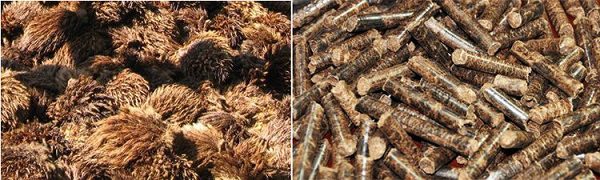
Fermentation process: High-temperature aerobic rapid composting
EFB has a high carbon-to-nitrogen ratio (approximately 80:1) and a compact fiber structure, requiring enhanced fermentation conditions.
C/N ratio adjustment: Add 20-30 kg of urea or 200-300 kg of chicken manure per ton of dry EFB to adjust the C/N ratio to 30:1.
Fermentation equipment: A trough-type fermentation system is used. Construct fermentation tanks 3-5 meters wide, 1.5 meters high, and 40-60 meters long, with high-pressure ventilation ducts at the bottom (0.3-0.5 m³/min airflow per square meter). Use a trough-type compost turner (with roller-type shovels) to turn the compost every 3 days. The turner should be equipped with anti-winding toothed discs to handle the long fibers of EFB.
Fermentation cycle: In tropical regions with high temperatures, fermentation takes 25-30 days to mature. Maturity indicators: EFB turns dark brown, has no odor, and the fibers soften and break easily when pinched.
III. Finished Product Processing and Export Value Mature EFB organic fertilizer can be sold directly as powder, but for export to European, American, Japanese, and Korean markets, granulation is usually required to improve marketability and facilitate transportation.
Granulation equipment: Due to the high fiber content of EFB, a disc granulator with bentonite binder (added 5%-8%) is recommended, or roller extrusion granulation (avoid adding water). Drying and Packaging: The moisture content of the granules needs to be reduced to below 15% using a low-temperature rotary dryer (inlet air temperature ≤120℃) to prevent fiber combustion. After cooling, the granules are automatically packaged into ton bags or 25kg laminated woven bags using an automatic packaging scale.
Export Value: EFB organic fertilizer is rich in potassium and silicon, making it a high-quality soil conditioner. After obtaining EU organic certification, the FOB price can reach $120-180/ton, far exceeding the negative benefits of direct incineration or landfill in the local area.

Summary: The key to producing organic fertilizer from EFB lies in “powerful shredding to solve fiber entanglement, trough ventilation to accelerate decomposition, and low-temperature granulation to retain nutrients.” This equipment solution has been successfully implemented in several plantations in Sabah, Malaysia, and Sumatra, Indonesia, solving the problem of waste accumulation and generating considerable export revenue. With the increasing global demand for sustainable palm oil, EFB resource utilization will become the industry standard. We specialize in the research and development and manufacturing of complete sets of equipment for the resource-based production of organic fertilizer from hollow palm fruit bunches (EFB), and provide localized solutions for Southeast Asia—from powerful shredding and anti-tangling, trough-type ventilation and rapid composting to low-temperature granulation and maintenance, providing a one-stop supply of the entire system.
The transformation of Oil palm empty fruit bunch (OPEFB) into high‑grade organic fertilizer is a proven pathway that turns a challenging waste stream into a valuable export commodity. The equipment solution outlined above – heavy‑duty dual‑shaft shredders, trough‑type fermentation systems with forced aeration, and low‑temperature granulation – directly addresses the fibrous, high‑moisture nature of EFB, ensuring efficient processing from raw bunch to finished granules. At the heart of the line is the granulator machine for organic fertilizer, which, combined with a disc or roller press and minimal binder, produces uniform granules that meet international market standards. For plantation owners and investors, the organic fertilizer equipment price for a complete EFB‑to‑fertilizer plant is highly competitive compared to the long‑term costs of waste disposal and environmental penalties, with payback periods typically under 24 months. An integrated organic fertilizer manufacturing plant not only solves local waste accumulation but also opens export opportunities to premium markets, where the uses of oil palm empty fruit bunch as a potassium‑rich soil conditioner are increasingly recognized. With growing global demand for sustainable palm oil, OPEFB‑based fertilizer represents both an environmental responsibility and a profitable business – turning a problematic byproduct into a cornerstone of circular agriculture.