
In the competitive organic fertilizer market, granule appearance often determines the first impression. Smooth, rounded granules not only look better and are easier to spread, but also reduce powdering during transport. The rounding machine is the core equipment for achieving this “beautifying” effect. This article analyzes how to produce pearl-like fertilizer granules from three aspects: the rounding principle, secondary rounding technology, and surface gloss enhancement.
I. Rounding Principle: The Art of Friction and Rolling
The core of the rounding machine is one or more high-speed rotating discs (or drums), which use centrifugal force and friction to shape irregular granules into spherical shapes.
Working Process: Prismatic, flat, or irregular granules produced by the granulator fall from the feed inlet into the rotating disc at the bottom of the rounding machine. The disc speed is usually controlled at 150-300 rpm, and the disc surface is covered with a wear-resistant polyurethane or rubber layer. Under the action of centrifugal force, the granules accelerate and roll along the disc wall, generating continuous friction between themselves and with the disc wall, gradually rounding off the edges.
Key parameters: Material residence time in the machine is 1-3 minutes. Too short a time results in insufficient rounding, while too long a time leads to excessive wear and even breakage of the particles. Suitable moisture range: Particle moisture content 10%-18%—too dry and dusty, too wet and clumping.
Difference from traditional rollers: Ordinary rollers rely on drop impact, resulting in low rounding efficiency and brittle particles; dedicated rounding machines use centrifugal force + friction, minimizing impact on particles and significantly improving roundness (roundness coefficient can be increased from 0.7 to over 0.92).
II. Two-stage rounding technology: From “relatively round” to “pearls”
Single-stage rounding machines have limited effectiveness for particles with poor initial shape (such as columnar particles from extrusion granulation). Two-stage continuous rounding has emerged to address this.
Structural composition: Two rounding machines are arranged in series or side-by-side, connected by a chute. The first-stage polishing machine operates at a slightly lower speed (180-220 rpm), primarily removing sharp edges and pre-forming the particles. The second stage operates at a slightly higher speed (250-300 rpm) for fine polishing, achieving a mirror-like smooth surface on the granules.
Process Advantages: Separating the “shaping” and “polishing” functions avoids time conflicts caused by operating a single machine simultaneously.
Processing capacity can be increased by over 30%, and the final particle roundness coefficient can reach 0.95-0.98 (approaching perfect spherical shape).
For organic fertilizer granules with a diameter of 2-6mm, the particle size distribution is more concentrated after the second-stage polishing, with a coefficient of variation (CV) < 10%.
Application Example: An organic fertilizer plant producing chicken manure granules still had 10% irregular particles after the first-stage polishing; after adding a second-stage polishing, the irregularity rate dropped to below 2%, and the customer return rate decreased by 80%.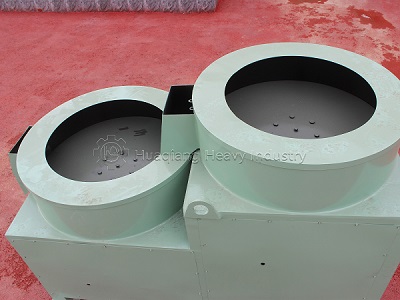
III. Surface Gloss: From Matte to Glossy
Polishing only achieves spherical shape, while gloss determines whether it is “pearl-like.” Improving gloss requires attention to three aspects:
Moisture and Temperature Control:Before polishing, maintain a moisture content of 12%-15% on the particles and keep them at room temperature (20-30℃). Too little moisture will cause powdering, while too much will result in a rough surface. A small amount of atomized water (0.2%-0.5%) can be applied at the inlet of the polishing machine to moisten the particle surface and increase lubrication.
Polishing Additives:In the second-stage polishing machine, vegetable oil, paraffin wax, or liquid polishing agents (such as polyethylene glycol) can be added at a ratio of 0.1%-0.3%. These additives form a very thin oil film on the particle surface, filling in microscopic scratches and significantly improving reflectivity.
Inner Wall Material and Speed Curve:The polishing disc and cylinder should be lined with polyurethane or rubber (Shore hardness 60-80), which is softer than metal, allowing the particle surface to be “glossed” rather than “scratched.” Simultaneously, a soft-start variable frequency speed control should be used, with low speed initially and high speed later, gradually increasing gloss.
Effect Verification: Organic fertilizer granules treated with two-stage polishing and additives show an improvement in gloss level (measured on a 60° angle gloss meter) from 10-15 to 35-45, exhibiting a visibly glossy and oily finish comparable to high-grade compound fertilizers.
IV. Equipment Selection and Maintenance Recommendations
Selection Points: Choose a turntable diameter (600-1600mm) based on production capacity, prioritizing 316L contact surface material. An automatic lubrication system and dustproof sealing cover are recommended.
Daily Maintenance: Check turntable wear every shift and change lubricating oil every 200 hours; clean residual material weekly to prevent clumping and maintain balance.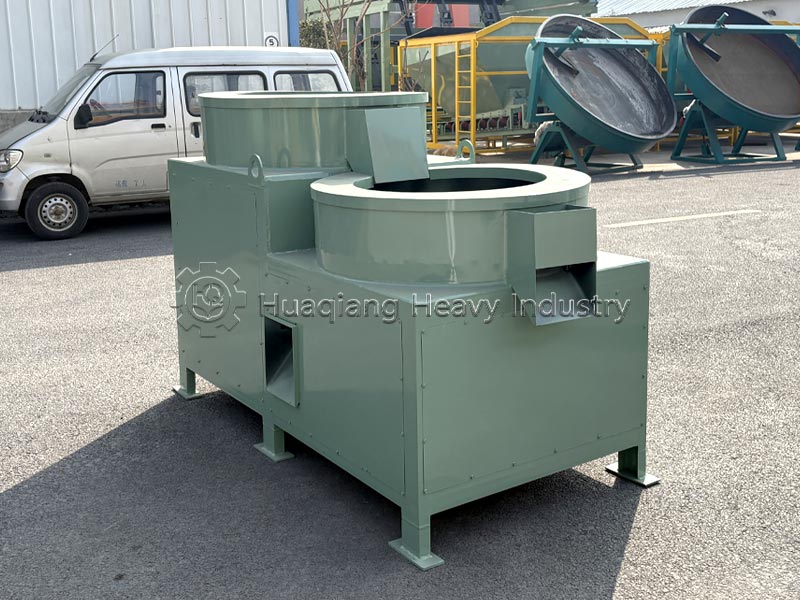
In summary, transforming standard organic fertilizer granules into pearl-like, high-gloss pellets is not an isolated operation—it demands the seamless synergy of advanced fertilizer production machine technology. The process begins upstream with reliable equipment such as a rotary drum granulator, a versatile fertilizer granulator machine, or a dedicated poultry manure pellet machine to create consistent base particles. These raw granules then enter the core of the solution: the fertilizer ball shaping machine (granule rounding machine) with its centrifugal friction, two-stage polishing, and gloss enhancement systems. Beyond perfect sphericity, the rounding action significantly improves fertilizer granules compaction—the intensive rolling densifies the outer layer, reducing dust, preventing breakage during transport, and boosting crushing strength. The resulting perfectly spherical and glossy pellets are exceptionally valuable for a bulk blending (BB) fertilizer line, where uniform particle size and shape eliminate segregation, guaranteeing consistent nutrient blending and easy flowability. Integrating the ball shaping machine after primary granulation bridges the gap between irregular agglomerates and premium-grade organic fertilizer, elevating roundness coefficient above 0.95 and surface gloss from matte to 40+ (60° gloss meter). Whether you process poultry manure, crop residues, or compound blends, adopting two-stage continuous rounding combined with moisture/temperature control and polishing additives unlocks a new level of market competitiveness. Embrace this holistic rounding approach, and every single granule will reflect the precision of modern engineering—transforming your product line into a benchmark of pearl-like excellence.
To produce pearl-like, rounded organic fertilizer granules, granulation alone is insufficient. Employing centrifugal friction polishing principles, configuring a two-stage continuous polishing unit, and combining moisture control and polishing additives, ordinary irregular granules can be upgraded into high-end products with a smooth surface and excellent roundness. If you are looking for solutions to improve the appearance and quality of organic fertilizer granules and enhance your competitiveness in the end market, please contact us. We provide complete sets of two-stage continuous polishing rounding machines and gloss enhancement process solutions. We offer full technical support, from turntable diameter selection to polishing additive ratio, helping you increase the granule roundness coefficient to over 0.95 and create pearl-like high-end organic fertilizer that will impress your customers at first glance.