
In organic fertilizer production, the turner is the core equipment that determines the success or failure of fermentation. Currently, the two mainstream types of self-propelled turners on the market—the large wheel turner and the windrow composting turner—while aiming at the same goal, differ significantly in their working principles and applicable scenarios. Understanding their differences can help organic fertilizer plants choose the right type.
Oxygenation Principle: Throwing vs. Turning
The large wheel turner relies on a giant wheel with a diameter of 1.5-2 meters, the wheel surface equipped with multiple wear-resistant blades. During operation, the wheel rotates at high speed (200-300 revolutions per minute), and the blades cut into the material and instantly throw it into the air 2-4 meters high, causing the material to scatter in a fan shape. This process forces the material into intense contact with the air, resulting in extremely high oxygen dissolution efficiency, while simultaneously breaking up clumps.
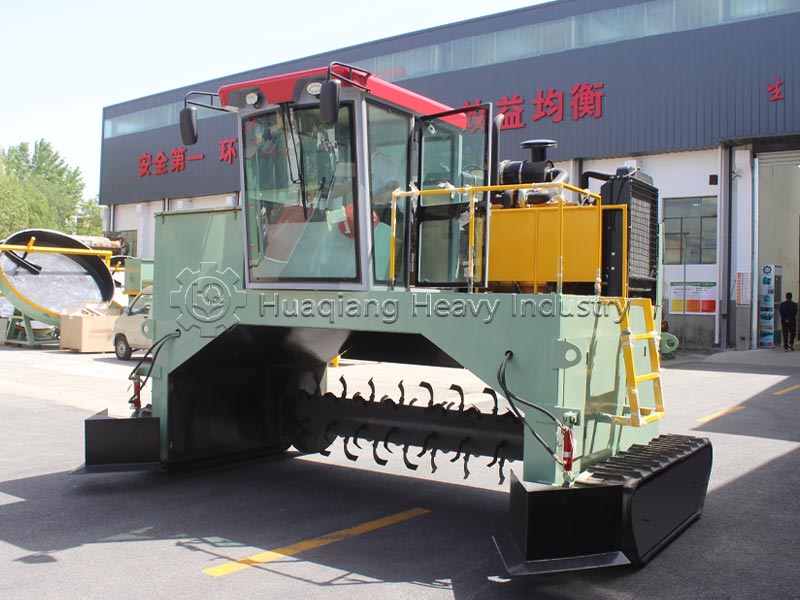
The windrow composting turner, on the other hand, uses a low-speed roller or chain plate structure. The drum has spirally arranged lifting plates welded on it. As it rotates (30-60 revolutions per minute), it scoops up the material from the bottom of the shovel, flips it over, and re-piles it. The material displacement path is similar to a “tumbling” process; although it is still loose, the throwing height is low, and the oxygenation method is mainly “interlayer displacement” rather than strong aeration.
Increased Fermentation Speed: Rapid Dehydration vs. Uniform Heating
Due to the different oxygenation intensities, the two methods significantly differ in their effect on accelerating the fermentation cycle. The large wheel type can repeatedly throw the material into the air, reducing the material’s moisture content by 3%-5% with each turn. Aerobic bacteria then metabolize rapidly in the oxygen-rich environment, typically shortening the traditional 45-day fermentation cycle to 20-25 days. This is especially noticeable when processing loose materials such as straw and furfural residue, where the wheel’s dual effect of crushing and aeration is significant.
The advantage of the shovel-type compost turner lies in its gentle and uniform action. It avoids over-crushing materials, preserving the porous structure within the strips, and ensuring a stable temperature rise (generally reaching 65℃ in 3-5 days), with an overall fermentation cycle of approximately 30-35 days. While its absolute speed is slower than the rotary wheel type, it is suitable for applications requiring the preservation of material fiber structure (such as seedling substrate production), preventing excessive pulverization.
III. Applicable Sites: Open Farms vs. Compact Plants
Large wheel compost turners have higher site requirements: they require strips at least 4-6 meters wide, a large turning radius, and a hardened or flattened surface. They are suitable for large open-air organic fertilizer plants and centralized processing areas in livestock farms, with a single machine capable of turning 300-500 cubic meters per day, offering extremely high efficiency.
Strip compost turners are more flexible and lightweight: their narrow body (1.5-2.5 meters wide) allows operation on strips up to 2.5 meters wide, with a small turning radius, even adapting to simple sites with a slight slope. They are particularly suitable for small organic fertilizer workshops, greenhouse production, or agricultural supply stations with limited land resources, and their investment cost is approximately 30% lower.

Strategic Equipment Selection in Modern Composting Operations
The evolution of fermentation composting turning technology has fundamentally reshaped how organic fertilizer plants approach raw material decomposition and quality control. For large-scale operations prioritizing throughput and rapid moisture reduction, investing in a robust large wheel compost turning machine delivers measurable advantages in cycle compression and material homogenization, particularly when processing bulky agricultural residues. Conversely, facilities requiring gentle handling of fibrous substrates or operating within constrained footprints will find that a compact windrow composting machine provides the operational flexibility and lower capital expenditure necessary for sustainable production. When specifically addressing the composting process for animal manure, selecting an appropriate animal manure compost turner becomes critical, as the high moisture and nitrogen content of livestock waste demands precise aeration management to prevent anaerobic pockets and odor emissions. Ultimately, the choice of turning equipment directly influences downstream efficiency across the entire fertilizer production process, from fermentation maturity to final product stability. As the industry advances, integrating intelligent monitoring systems with proven fertilizer granulation technology will enable manufacturers to transform composted organic matter into premium, market-ready granular fertilizers, thereby maximizing both agronomic value and commercial profitability in an increasingly competitive landscape.
In summary: For those seeking maximum fermentation speed, handling high-moisture and high-viscosity materials, and with ample space, a large rotary drum fermenter is the better choice; however, if the integrity of the raw material fibers is important, working space is limited, or multiple product rotations are required, a strip-chopping fermenter is more practical. Neither method is inherently superior; the key is finding the method that best suits your specific process conditions.