
What is the safe production of high-nitrogen NPK compound fertilizer?
High-nitrogen NPK compound fertilizer refers to a compound fertilizer formula with a nitrogen content exceeding 25%, typically represented by 25-10-10 and 28-5-7. Urea typically accounts for 40% to 55% of the high-nitrogen formula. Urea is prone to hydrolysis in high-temperature and high-humidity environments, generating free ammonia. When mixed with oxidizing nitrogen sources such as ammonium nitrate, there is a risk of thermal decomposition and explosion. The core of safe production lies in controlling the granulation temperature, isolating incompatible components, and managing static electricity and dust accumulation.
Temperature Red Line: Thermal Control in the Granulation Process When urea and monoammonium phosphate are heated by steam in a drum granulator, if the material temperature exceeds 75 degrees Celsius, the urea hydrolysis rate increases sharply—approximately 2.5 times for every 10-degree Celsius increase. The increased free ammonia concentration not only causes nitrogen loss but also creates an explosive atmosphere within the granulator. The steam pressure of high-nitrogen formulations should be strictly controlled within the range of 0.15 to 0.25 MPa, corresponding to a material temperature maintained between 55 and 65 degrees Celsius. The rotary drum granulator needs to be equipped with an online infrared temperature monitor, with one monitoring point in the middle section of the drum and one at the discharge end. Exceeding the temperature limit will automatically cut off the steam and trigger an audible and visual alarm. The drying process is equally critical: the inlet hot air temperature of the rotary dryer must not exceed 180 degrees Celsius, and the outlet material temperature must be controlled below 50 degrees Celsius. A three-stage temperature control strategy should be adopted—preheating section 120 to 150 degrees Celsius, main drying section 150 to 180 degrees Celsius, and cooling section ambient temperature—to avoid localized overheating. The drying time for high-nitrogen formulations is 20% to 30% shorter than that of conventional formulations, reducing heat exposure time.
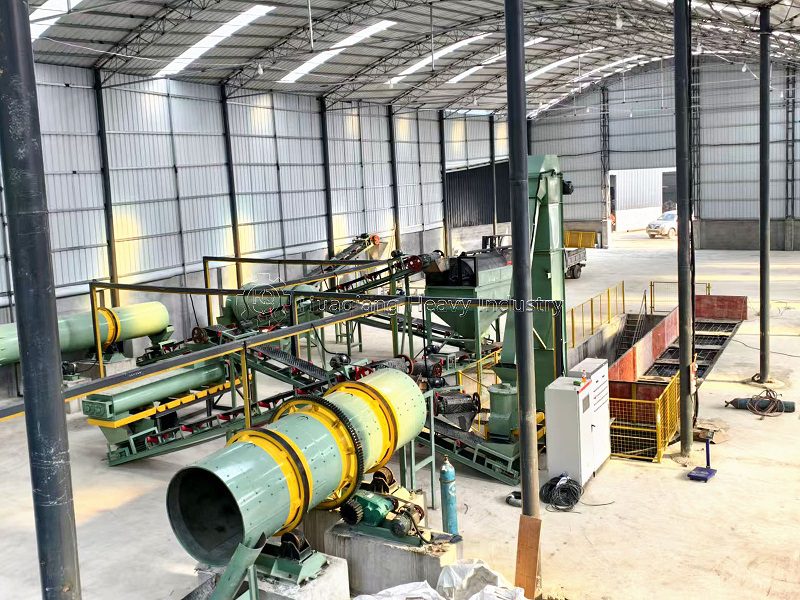
Component Isolation: Incompatibilities of Redox Systems
If a high-nitrogen formulation contains both ammonium nitrate and organic matter (such as humic acid or coating agents), a redox reaction can occur above 60 degrees Celsius, releasing a large amount of gas and heat. During the formulation design phase, a compatibility matrix review is required: ammonium nitrate and urea can coexist, but their total amount should not exceed 50% of the formulation; ammonium nitrate is strictly prohibited from being used in the same formulation as sulfur or metal powders; mixing chlorine-containing raw materials (potassium chloride) with ammonium nitrate will reduce thermal stability, and it is recommended to use potassium sulfate instead. In terms of the layout of the mixing silos, the distance between the storage silos for ammonium nitrate and reducing materials should not be less than 10 meters, and the conveying pipelines should be independently set up. The mixer should be made of stainless steel and grounded to prevent static electricity. The mixing time should be controlled within 3 to 5 minutes to avoid excessive friction and heat generation. Before each batch of production, a “no-load temperature rise test” should be performed—a small amount of each component in the formulation is mixed and placed in a sealed container and heated to 80 degrees Celsius. The temperature rise is observed to be no more than 5 degrees Celsius within 24 hours; if the temperature rise exceeds the limit, the formulation is deemed unsafe.
Dust Explosion Prevention: Complete Chain Interception from Accumulation to Ignition The lower explosive limit concentration of high-nitrogen dust is approximately 30 to 50 grams per cubic meter, far lower than the 80 to 120 grams of ordinary NPK dust. Dust-generating points—crushers, mixers, and packaging machines—must be equipped with explosion-proof pulse bag filters. Filter bags should be made of anti-static polyester needle-punched felt, and the grounding resistance of the equipment casing should be less than 4 ohms. The air velocity in the dust collection ducts should be maintained at 18 to 22 meters per second, with cleaning inlets every 6 meters in horizontal sections, and the radius of curvature of bends should be no less than three times the pipe diameter. Open flame operations are strictly prohibited in the workshop. Electrical equipment must be explosion-proof with a rating of Ex d IIB T4 or higher. The packaging process has the highest risk of static electricity buildup; conductive woven bags should be used for packaging, or ionizers should be installed at the filling port to eliminate static electricity. It is recommended to commission a third-party testing agency to measure dust explosiveness parameters—maximum explosion pressure, maximum pressure rise rate, and minimum ignition energy—quarterly to establish a dynamic risk file.
High-nitrogen NPK production lines must be equipped with independent emergency response tanks, with a volume no less than 1.5 times the maximum material quantity per batch, for receiving leaked wastewater or fire-fighting wastewater. The workshop must be equipped with fixed sprinkler systems and portable dry powder fire extinguishers; the use of carbon dioxide fire extinguishers is strictly prohibited (urea decomposes at high temperatures, producing toxic gases). Operators must receive specialized training every six months, including identifying signs of thermal decomposition, emergency shutdown procedures, and evacuation routes. It is recommended to introduce a Safety Instrumented System (SIS) that operates independently of the DCS control system. When any parameter (temperature, pressure, or flammable gas concentration) triggers interlocking conditions, the system should automatically implement safety measures, such as cutting off the feed, opening pressure relief valves, and activating the sprinkler system. Safe production of high-nitrogen compound fertilizers is not a simple equipment upgrade, but a systematic project encompassing formula design, process parameters, equipment selection, and personnel management.
Safe production of high-nitrogen NPK compound fertilizer transcends isolated equipment upgrades, demanding a holistic safety culture embedded throughout the entire NPK fertilizer line. Every piece of fertilizer equipment—from granulators and dryers to conveyors and packaging units—must be selected, installed, and maintained with explosion-proof and anti-static specifications as non-negotiable prerequisites. For facilities processing urea-dominant formulations, transitioning from steam drum systems to a roller press granulator production line can significantly mitigate thermal risks by eliminating high-temperature steam injection and reducing material exposure to elevated temperatures. Regardless of granulation modality, robust fertilizer screening equipment with grounded casings and anti-static filter media is essential for intercepting dust accumulation before it reaches explosive concentrations. While an organic fertilizer disc granulator is typically reserved for organic-inorganic blends, its low-temperature, ambient-pressure operation offers valuable design insights for retrofitting high-nitrogen disc granulation production line configurations that minimize thermal stress. Ultimately, the fertilizer granulator machine and all associated process units must operate under the supervision of an independent Safety Instrumented System, ensuring that temperature excursions, incompatible material contact, and dust concentration spikes trigger automatic protective responses before human intervention is required. Only through this integrated approach—combining engineered safeguards, rigorous operator training, and continuous risk assessment—can high-nitrogen fertilizer production achieve the dual objectives of operational safety and commercial viability.