
What are Organic Fertilizer Raw Materials?
Organic fertilizer raw materials refer to natural materials containing organic matter used in the production of commercial organic fertilizers. After microbial fermentation and decomposition, they provide organic matter and plant nutrients to the soil. High-quality raw materials should possess three basic characteristics: organic matter content not less than 40%, a suitable carbon-to-nitrogen ratio (20:1 to 35:1), and heavy metal and pathogen content below national limits. The selection of raw materials directly determines the quality of the final product, fermentation efficiency, and production costs.
Livestock and Poultry Manure: A Major Source of Nitrogen
Livestock and poultry manure is the most traditional raw material for organic fertilizer. Its characteristics include high nitrogen and phosphorus content and rapid fermentation temperature rise. Chicken manure contains 1.5% to 3.0% nitrogen, 1.2% to 2.0% phosphorus pentoxide, 0.8% to 1.5% potassium oxide, and 45% to 60% organic matter. However, chicken manure often contains coccidia eggs and Salmonella, requiring a high-temperature fermentation period of at least 55 degrees Celsius for at least 10 days. Pig manure contains 0.8% to 1.5% nitrogen and 45% to 55% organic matter. Its fibers are finer, and its fermentation cycle is 3 to 5 days shorter than chicken manure. Cow manure has the lowest nitrogen content (0.5% to 1.0%), with a carbon-to-nitrogen ratio of approximately 20:1 to 25:1. It needs to be adjusted to around 30:1 by adding carbon sources such as straw. Sheep manure falls between cow and chicken manure, with balanced properties, making it a relatively ideal substrate. It is recommended to mix two or more types of manure to obtain a more balanced nutrient profile.
Crop Straw: Carbon Source and Structure Regulator
Straw raw materials have a high carbon content (70% to 85% organic matter), with a carbon-to-nitrogen ratio typically between 50:1 and 100:1. They cannot be fermented alone, but when mixed with manure, they can serve as a carbon source and increase the porosity of the compost pile. Corn straw has a carbon-to-nitrogen ratio of approximately 60:1 to 70:1. The required crushing length is 2 to 5 cm; too short a length will cause compaction and oxygen deficiency, while too long a length will cause it to entangle with the knives during turning and scattering. Wheat straw has a carbon-to-nitrogen ratio of approximately 80:1 and a thick waxy surface layer; it is recommended to mix it with manure and pre-moisten it for 24 hours before piling. Rice straw has a carbon-to-nitrogen ratio of approximately 65:1, a high silicon content, and decomposes slowly, requiring a fermentation cycle extended by 5 to 10 days. Soybean straw has a low carbon-to-nitrogen ratio (30:1 to 35:1) and a high nitrogen content (1.0% to 1.5%), making it a high-quality raw material among straw types. All straw should be ensured to be free of pesticide residues and disease infections before use.
III. Industrial Organic Waste: Low-Cost Regional Raw Materials Food processing byproducts are raw materials with significant cost advantages. Oilseed cakes such as soybean meal, rapeseed meal, and cottonseed meal have nitrogen contents as high as 4% to 7%, with a carbon-to-nitrogen ratio of only 5:1 to 10:1, and must be used in combination with high-carbon raw materials. Distillery lees (beer lees, liquor lees) contain 2% to 4% nitrogen and 75% to 85% organic matter, with a carbon-to-nitrogen ratio of 15:1 to 20:1, but a high moisture content of 75% to 85%, requiring pre-filtration to reduce it to below 65%. Sugar mill filter mud contains 40% to 60% organic matter and 10% to 20% calcium carbonate, which can help adjust the pH of the compost pile. Mushroom residue is partially decomposed cellulose material, and its fermentation cycle can be shortened to 15 days. Residue from traditional Chinese medicine extraction contains alkaloid residues and must be confirmed to be non-toxic before use. Heavy metal and salt content should be tested before using industrial waste.
Urban Organic Waste: Potential Raw Materials Supported by Policy Kitchen waste has a high organic matter content (80% to 90%), but also a high oil and salt content (0.5% to 1.5% salt). It requires oil-water separation and desalination pretreatment before use in organic fertilizer production; otherwise, long-term application will lead to soil salinization. Garden waste (pruned branches and fallen leaves) has a high lignin content and needs to be crushed to below 3 cm and thoroughly mixed with a nitrogen source, with a fermentation cycle of 35 to 45 days. Municipal dewatered sludge has an organic matter content of 35% to 50% and a nitrogen content of 2% to 4%, but heavy metals are the main risk—it must pass testing and heavy metal passivation treatment before use (as detailed above). These raw materials often enjoy government subsidies (US$20 to US$60 per ton), making them economically viable.

Recommendations for Raw Material Combination and Proportioning: It is difficult for a single raw material to simultaneously meet the requirements of organic matter, carbon-nitrogen ratio, and physical structure. A recommended compound formulation is: 50% to 70% manure (providing a nitrogen source), 20% to 40% straw (providing a carbon source and porosity), and 5% to 10% functional additives (oil cake, mushroom residue, etc.). The carbon-nitrogen ratio after mixing should be controlled at 25:1 to 30:1, with a moisture content of 55% to 65% and a pH value of 6.0 to 8.0. Each batch of raw materials should be sampled and tested for moisture content, carbon-to-nitrogen ratio, and heavy metals upon arrival at the factory, and a raw material file should be established. The storage conditions for raw materials are equally important: livestock and poultry manure should be stored in a leak-proof storage area, straw should be dry and mold-proof, and industrial waste should be classified, labeled, and processed on a first-in, first-out basis. A stable supply of high-quality raw materials is a prerequisite for the consistent quality of commercial organic fertilizer.
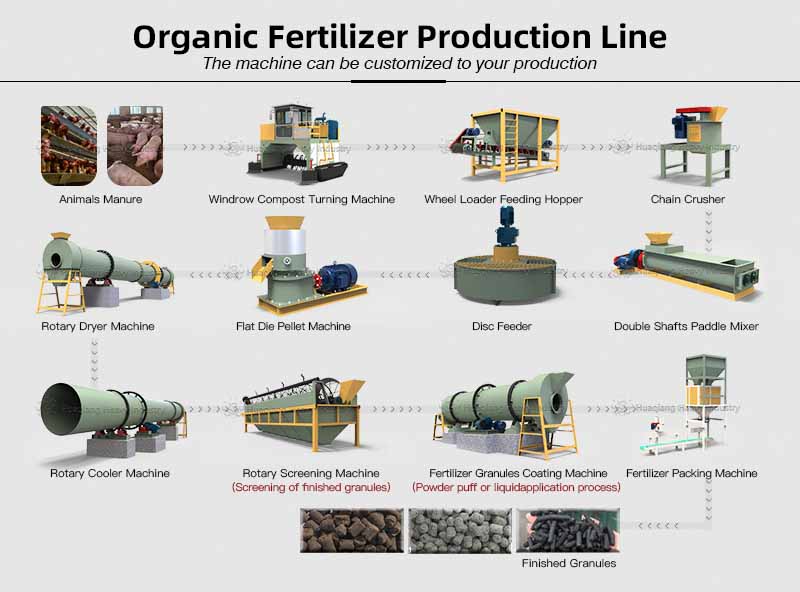
The strategic selection and proportioning of raw materials constitute the foundational pillar of any successful organic fertilizer manufacturing plant, directly dictating fermentation efficiency, nutrient profile, and end-product marketability. A well-designed facility integrates an animal manure processing machine for initial solid-liquid separation and impurity removal, followed by a controlled organic fertilizer fermentation process that maintains thermophilic conditions for pathogen inactivation and organic matter stabilization. Upon maturity, the composted material feeds into a granulator machine for organic fertilizer, where particle size, density, and moisture are precisely controlled to produce uniform pellets suitable for mechanized spreading. When evaluating organic fertilizer equipment price, producers must balance upfront capital expenditure against long-term operational savings—automated batching, real-time C/N ratio monitoring, and energy-efficient turning systems typically yield ROI within 18 to 24 months. Ultimately, the entire organic fertilizer machine ecosystem—from raw material intake through fermentation to finished product packaging—must operate as an integrated continuum, ensuring that every ton of livestock manure, crop residue, or industrial byproduct is transformed into a certified, high-value soil amendment that supports sustainable agriculture and circular economy objectives.