
What is Sludge-Based Organic Fertilizer?
Sludge-based organic fertilizer refers to an organic soil conditioner made from dewatered sludge produced by municipal wastewater treatment plants through processes such as heavy metal stabilization, aerobic fermentation, and deep composting. Sludge contains abundant organic matter (30% to 50%), nitrogen and phosphorus nutrients (2% to 4% nitrogen, 1% to 2% phosphorus pentoxide), and trace elements necessary for plant growth. However, untreated sludge contains pathogens, parasite eggs, and potential heavy metal risks, and must be rendered harmless and stabilized through a standardized fermentation process.
Raw Material Pretreatment: Dual Control of Moisture and Impurities
The moisture content of mechanically dewatered sludge from wastewater treatment plants is typically between 75% and 85%. Direct fermentation would lead to oxygen deficiency. The first step in pretreatment is to adjust the moisture content—adding auxiliary materials such as sawdust, rice husks, and chopped straw to reduce the moisture content of the mixture to 60% to 65%. The auxiliary material addition is 0.3 to 0.5 tons per ton of wet sludge. The second step is to remove impurities by separating stones, fibers, plastics, and other debris using a drum screen (10 to 15 mm mesh). The third step is to adjust the carbon-to-nitrogen ratio—the carbon-to-nitrogen ratio of sludge is usually 5:1 to 10:1, and carbon source auxiliary materials need to be added to increase it to 25:1 to 30:1. Approximately 80 to 120 kg of chopped straw or 40 to 60 kg of sawdust needs to be added per ton of sludge.
Aerobic Fermentation: The Core Process of Harmless Treatment The pretreated mixture is piled for fermentation. A trough fermentation system with forced ventilation is recommended: the fermentation trough is 3 to 5 meters wide and 1.2 to 1.5 meters high, with perforated ventilation pipes at the bottom. The compost turner turns the compost every 1 to 2 days, and the forced ventilation rate is configured at 0.2 to 0.5 cubic meters per minute per cubic meter of material. The temperature of the compost pile should rise to above 55 degrees Celsius within 48 hours and be maintained between 55 and 65 degrees Celsius for at least 10 days. This temperature and duration are sufficient to kill roundworm eggs (inactivated within 7 days at above 55 degrees Celsius), Salmonella (inactivated within 30 minutes at above 60 degrees Celsius), and E. coli. The fermentation cycle is 20 to 30 days. After fermentation, the material is dark brown, odorless, and loose in texture.
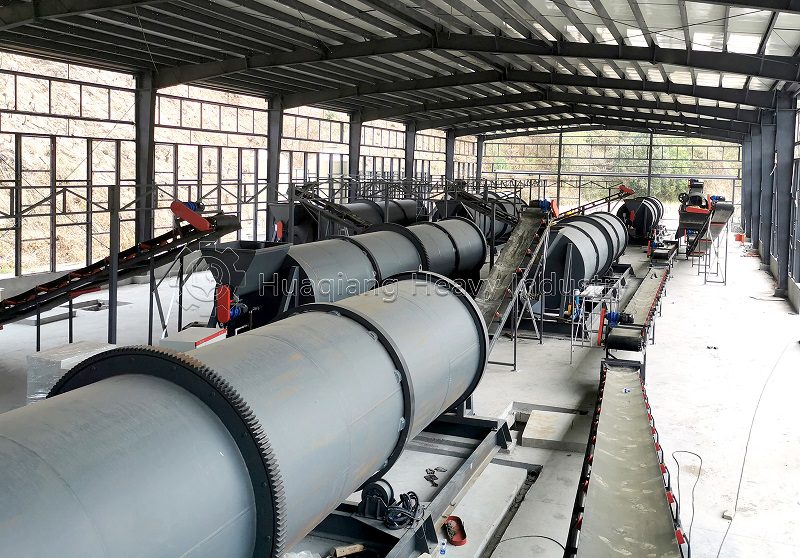
III. Heavy Metal Passivation: A Key Guarantee of Safety Heavy metals (such as zinc, copper, lead, and cadmium) in sludge are a major source of risk in the application of organic fertilizers. Adding heavy metal passivating agents during or after fermentation can convert them into an insoluble form, reducing bioavailability. Commonly used passivating agents include: apatite (2% to 5%), zeolite powder (3% to 6%), lime (1% to 3%), and biochar (5% to 10%). After thorough mixing of the passivating agent with the composted material, curing for 7 to 10 days can reduce the proportion of exchangeable heavy metals by 30% to 50%. The application standard for the finished sludge organic fertilizer should refer to the “Standard for Pollutant Control of Agricultural Sludge” (GB 4284-2018)—total cadmium in acidic soil (pH less than 6.5) should not exceed 5 mg/kg, and total lead should not exceed 300 mg/kg. Each batch of finished product must be tested for heavy metal content.
- Deep Dehydration and Crushing/Screening The moisture content of the fermented and composted material remains at 40% to 50%, and needs to be further reduced to below 30% to facilitate granulation and storage. It is recommended to use a high-pressure filter press or plate and frame filter press for secondary dehydration, which can compress the moisture to 25% to 35%. The dehydrated material is then broken up by a semi-wet material crusher (90% of the output fineness passes through a 3 mm screen), and then enters a drum screen (2 to 4 mm screen opening). The undersize material is the finished organic fertilizer powder, while the oversize material (incompletely decomposed fibers and impurities) is returned to the fermentation system for further processing.
- Granulation and Packaging (Optional) To improve marketability, a roller extrusion granulator is recommended for producing granular sludge organic fertilizer. Extrusion granulation requires no binder, compressing the powder into granules under a linear pressure of 150 to 250 MPa, achieving a compressive strength of 15 to 25 Newtons. The moisture content of the granules after extrusion is approximately 25% to 30%. For further moisture reduction to extend shelf life, a low-temperature belt dryer (hot air temperature 60 to 80 degrees Celsius) can be installed to reduce the moisture content to below 20%. The finished product is automatically packaged into 25 kg or 50 kg bags. The investment for a granulation unit is approximately US$20,000 to US$40,000, suitable for production lines with an annual output of 5,000 tons or more.
In summary, sludge-based organic fertilizer production embodies the principles of a circular economy. Through rigorous stabilization and fermentation processes, it transforms municipal sewage residue into a safe, nutrient-rich soil conditioner. Choosing suitable fertilizer production equipment is crucial, as each piece of equipment must withstand the corrosive and high-humidity environment unique to sludge treatment, while ensuring pathogen inactivation and heavy metal passivation. In the core granulation stage, the fertilizer granulator (typically a roller extruder operating at 150-250 MPa) compresses stabilized sludge powder into durable granules with a compressive strength of 15-25 Newtons, without the use of chemical binders and maintaining the organic integrity of the material. Equally vital is the fertilizer crushing and mixing component, which achieves a fertilizer fineness of less than 3 mm for 90% of the samples and ensures uniform distribution of passivating agents (such as apatite, zeolite, or biochar), thereby reducing the bioavailability of exchangeable heavy metals by 30% to 50%. After granulation, the fertilizer dryer operates at a controlled temperature of 60 to 80°C, reducing the moisture content from 25% to 30% to below 20%, preventing microbial reactivation and extending its shelf life under tropical storage conditions. When evaluating the price of industrial fertilizer machinery, operators should assess the full life-cycle cost, including corrosion-resistant materials, energy consumption under forced ventilation conditions, and compliance testing infrastructure, rather than focusing solely on the initial purchase price. Finally, automated fertilizer packaging machines ensure the hygienic and precise packaging of fertilizer into 25 kg or 50 kg units, thus completing the entire production chain and transforming environmental responsibility into agricultural assets.