
What is a Sheep Manure Processing Production Line?
A sheep manure processing production line refers to a complete set of equipment that uses sheep manure as a single or core raw material, transforming it into commercial organic fertilizer through processes such as solid-liquid separation, aerobic fermentation, crushing and screening, granulation, and packaging. Sheep manure has a balanced nitrogen, phosphorus, and potassium content (approximately 0.8% to 1.2% nitrogen, 0.4% to 0.8% phosphorus pentoxide, and 0.5% to 1.0% potassium oxide), is rich in organic matter (45% to 60%), and has fine, soft fibers, making it superior to chicken manure (high nitrogen content but high antibiotic risk) and cow manure (low nitrogen content, slow fermentation). However, because sheep manure often contains urine and wool residue, targeted pretreatment equipment is required.
Solid-Liquid Separation: Removing Free Water and Impurities
Fresh sheep manure typically has a moisture content between 65% and 75% and contains wool, sand, and undigested grass seeds. A screw extrusion solid-liquid separator can reduce the moisture content to 55% to 60% while removing free urine (lowering ammonia nitrogen concentration). The volume of the separated solid material is reduced by 30% to 40%, facilitating subsequent stacking. If wool needs to be removed, a drum screen (8 to 10 mm mesh) should be added before the separator. This combination of screening and air separation separates the wool—wool is light and has long fibers, which are carried into the collection pipe by the airflow during drum rotation, achieving a removal rate of over 80%.
Tank-type Aerobic Fermentation: The Core of Rapid Composting Sheep manure has fine, soft fibers and a carbon-to-nitrogen ratio of approximately 12:1 to 18:1, resulting in rapid fermentation temperature rise but a relatively short high-temperature period. A trough-type turning fermentation system is recommended: the fermentation tank should be 3 to 5 meters wide and 1.2 to 1.5 meters high, with forced ventilation ducts at the bottom (airflow rate of 0.2 to 0.4 cubic meters per minute per cubic meter of material). Mixed Auxiliary Materials – Add 30-50 kg of chopped straw or 20-30 kg of rice husks per ton of sheep manure to increase the carbon-to-nitrogen ratio to 25:1-30:1. Turn the pile every 1-2 days using a track-mounted turner. The sheep manure pile will reach 55-60 degrees Celsius within 48 hours, maintaining this high temperature for 8-12 days (Note: Sheep manure heats up quickly but also cools down quickly; sufficient oxygen supply must be ensured for the first 10 days). The total fermentation cycle is 18-25 days, 5-7 days shorter than chicken manure. After fermentation, the material is dark brown and has no manure odor.
III. Crushing and Screening: Refining Organic Matter
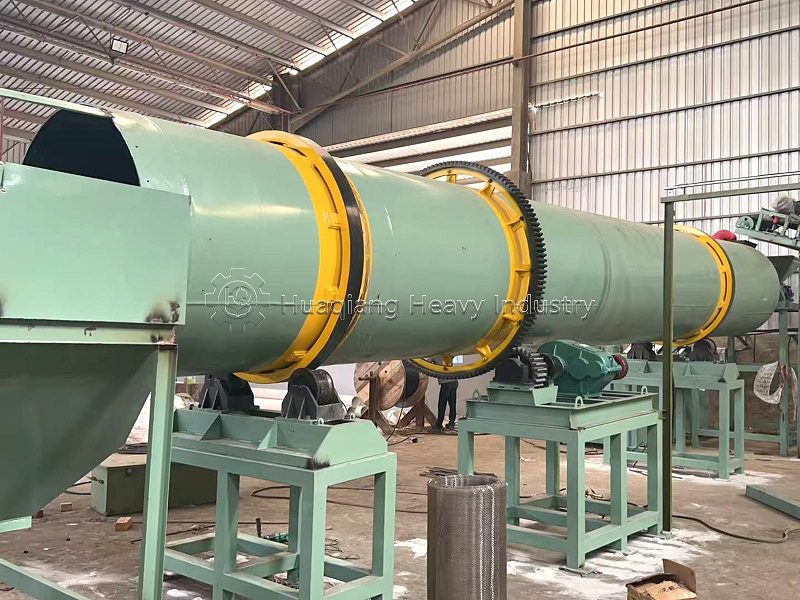
The fermented sheep manure fibers have partially softened, but a small amount of fiber clumps and grass seed husks remain. Use a semi-wet material crusher (22-37 kW) to break up the material, requiring 90% of the output to pass through a 3 mm screen. Then, it enters a drum screen (2-4 mm mesh), and the undersize material is a powdered organic fertilizer semi-finished product. The material left over from the sieve (fiber clumps, grass seed husks, etc.) is returned to the fermentation tank or used directly as bedding. The energy consumption for crushing sheep manure is approximately 1.2 times that of chicken manure due to its stronger fiber toughness. It is recommended that the crusher blades be made of high-wear-resistant alloy steel and inspected or replaced after processing 300 to 500 tons.
Granulation and Packaging: Enhancing Marketability Sheep manure organic fertilizer has a high fiber content, making a roller extrusion granulator the optimal choice. The material is compacted into granules under a linear pressure of 150 to 250 MPa, eliminating the need for binders and drying (moisture content is 30% to 35% after fermentation, decreasing to 25% to 30% after extrusion). The granules are lentil-shaped or irregular in shape, with a compressive strength of 12 to 20 Newtons. To further improve granule roundness, a disc granulator can be used with the addition of a small amount of moisture (5% to 8%), but a low-temperature dryer is required. The finished product is packaged into 25 kg or 50 kg bags using an automatic packaging scale.
Production Line Configuration and Investment Reference: A sheep manure organic fertilizer production line with an annual output of 5,000 tons (processing approximately 15 tons of fresh manure per day) requires an equipment investment of approximately US$60,000 to US$120,000. The solid-liquid separation unit accounts for 10%, the fermentation and turning system for 30% to 40%, the crushing and screening for 15% to 20%, and the granulation and packaging for 25% to 35%. Annual operating costs mainly include the purchase of auxiliary materials (straw, rice husks), electricity, labor, and equipment maintenance, with a comprehensive cost of approximately US$40 to US$70 per ton of product. The selling price of the finished product varies depending on whether it is in granular or powder form: US$60 to US$100 per ton for powder products and US$100 to US$180 per ton for granular products. The investment payback period is typically 2 to 3 years.
Unique Advantages of Sheep Manure Production Lines: Compared to other livestock and poultry manure, sheep manure treatment lines offer significant economic advantages: Firstly, antibiotic residues in sheep manure are significantly lower than in intensive chicken and pig farming, making it easier for products to obtain organic certification; secondly, sheep manure granules naturally have excellent disintegration properties, dispersing quickly in the soil when used as organic fertilizer; thirdly, in major pastoral areas such as Inner Mongolia, Xinjiang, Hebei, and Australia and New Zealand, the cost of collecting sheep manure raw materials is extremely low (even negative, as farms need to pay for removal). It is recommended to prioritize sheep manure organic fertilizer projects in these regions and strive for local subsidies for the resource utilization of agricultural waste.
In conclusion, establishing a comprehensive sheep manure processing system requires careful selection of each organic fertilizer machine to ensure seamless integration from raw material pretreatment to finished product packaging. The granulator machine for organic fertilizer plays a pivotal role in transforming fermented material into marketable granules, with roller extrusion technology proving particularly effective for high-fiber sheep manure due to its binder-free operation and low energy consumption. When evaluating the organic fertilizer equipment price, investors should consider not only initial procurement costs but also long-term operational efficiency, blade wear rates, and auxiliary material requirements, as these factors collectively determine the true return on investment. A well-designed organic fertilizer manufacturing plant leveraging sheep manure’s low antibiotic residue and superior granule disintegration properties can achieve organic certification more readily and command premium market prices. Furthermore, the Animal manure processing machine ecosystem—including solid-liquid separators, trough turners, and crushers—must be precisely matched to sheep manure’s unique characteristics, such as its rapid temperature rise and wool content. For operations requiring enhanced granule roundness, the addition of a fertilizer drying and cooling machine becomes essential to stabilize moisture levels and prevent caking during storage. Ultimately, sheep manure processing lines offer exceptional economic viability in pastoral regions, with payback periods of 2–3 years, making them a strategic choice for sustainable agricultural waste valorization.