
What is a Disc Granulator?
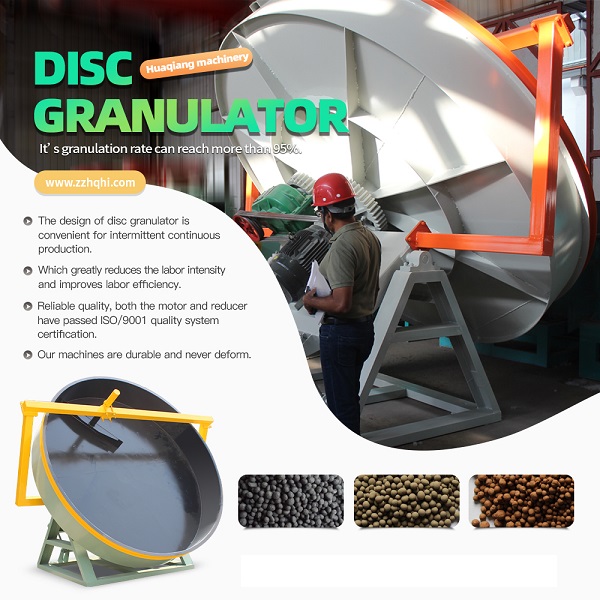
A disc granulator is a device that uses the rotating motion of an inclined disc to agglomerate powdery materials into spherical granules. It is widely used in the production of compound fertilizers, organic fertilizers, and blended fertilizers. Its core working principle is: the material rises to a certain height within the rotating disc and then rolls down under gravity. Simultaneously, water or a binder is sprayed into the nozzles, causing the fine powder to be layered and forming spherical granules. Disc granulators have a simple structure, produce good-looking granules, and are flexible in operation, making them ideal for small-batch, multi-variety production.
I. Installation and Commissioning: Setting the Reference Angle and Rotation Speed
Two key parameters of the disc granulator must be determined during the trial run. The disc inclination angle is generally set between 45 and 55 degrees—the larger the inclination angle, the shorter the residence time of the material in the disc, resulting in smaller particle sizes; the smaller the inclination angle, the longer the residence time, and the larger the particles tend to be. When commissioning a new machine, it is recommended to start at 50 degrees Celsius, observe the particle size distribution of the output, and then make fine adjustments. The disc rotation speed is typically 15 to 25 revolutions per minute. Higher speeds result in greater centrifugal force, increasing the proportion of fine powder being ejected and decreasing the granulation rate. For every 5 revolutions per minute increase in speed, it is recommended to decrease the tilt angle by 2 to 3 degrees to maintain granulation effect. Perform a no-load test run for at least 2 hours, checking for disc wobbling and ensuring the bearing temperature rise does not exceed 40 degrees Celsius.
II. Material Preparation: Moisture and Fineness Standards for Input Materials entering the disc granulator must meet two prerequisites. Fineness requirement: Over 95% of the material should pass through an 80-mesh standard sieve (0.178 mm aperture). Coarse particles or fibers in the disc will hinder fine powder agglomeration, resulting in rough particle surfaces and insufficient strength. If the raw material fineness does not meet the standard, a vertical chain crushing process should be added before granulation. Moisture requirement: The basic moisture content of the mixture should be controlled between 28% and 35%. When the moisture content is below 25%, granulation is difficult and dust is abundant; when it is above 38%, the material adheres to the bottom of the disc and the granules become soft and collapsed. Judgment method: The material clumps when squeezed in the hand, crumbles easily upon light touch, and leaves a damp mark on the palm but does not drip. If the moisture content is insufficient, add more moisture during the granulation process via the disc spray system; if the moisture content is too high, return to drying or add dry powder to adjust.
III. Operation Control: Dynamic Adjustment of the Granulation Process
Parameter adjustment during the production process follows the principle of “adjusting the disc based on the material.” The feed rate should be continuous and uniform. It is recommended to use a variable frequency screw feeder, with instantaneous feed fluctuations controlled within ±5%. Excessive feed will result in an excessively thick material layer and small particles being carried away; insufficient feed will expose the bottom of the disc and reduce the granulation rate. The spray system uses pressure atomizing nozzles (water pressure 0.2 to 0.4 MPa), with a spray volume of approximately 5% to 12% of the dry feed rate. The nozzles are installed at the bottom of the disc in an upward direction, with the spray width covering one-third of the bottom area of the disc. The water spray volume follows the principle of “small amounts, multiple times”: each batch of material is added in 3 to 5 installments to avoid excessive water intake at once, which can cause particle sticking. Particle size control is achieved by adjusting the tilt angle and residence time—increase the tilt angle to 53 to 55 degrees when small particles (1 to 3 mm) are needed; decrease the tilt angle to 45 to 48 degrees when large particles (3 to 5 mm) are needed. A scraper is installed at the discharge port to promptly remove finished particles.
IV. Maintenance: Key Measures to Extend Service Life At the end of each shift (8 hours), the following tasks must be completed: Clean the accumulated material adhering to the bottom and edges of the disc; the accumulated material thickness should not exceed 5 mm; check if the nozzles are clogged and blow them out with compressed air in the reverse direction; check the gap between the scraper and the bottom of the disc (should be maintained at 3 to 5 mm); excessive gap will create dead corners for material accumulation. Check the wear of the disc liner (rubber or polyurethane material) weekly; replace it if the wear depth exceeds 3 mm. Check the reducer lubricating oil level and bearing seat fastening bolts monthly. Add lithium-based grease to the disc spindle bearing every 2000 hours of operation. If the machine is shut down for more than 3 days, the remaining material in the disc should be drained and the disc rinsed with clean water to prevent the material from hardening and becoming difficult to clean.
Excessive granulation dust: Check if the moisture content of the base material is below 25%, if the spray water volume is sufficient, and if the nozzles are clogged. Insufficient particle strength: Check if the material fineness meets the standard, if the spray liquid is evenly distributed, and try adding 2% to 4% bentonite or sodium humate as a binder. Uneven particle size: Check if the feeding is continuous and if the inclination angle is constant; the rotation speed can be appropriately reduced to allow the material to tumble more thoroughly. Severe material sticking to the bottom of the disc: Check if the material moisture content is too high (above 38%), if the scraper gap is too large, and if the disc rotation speed is too slow. After mastering the above operating points, the granulation rate of the disc granulator can be stabilized at 65% to 75%, and the roundness of the granules can meet the standards for commercial fertilizer.
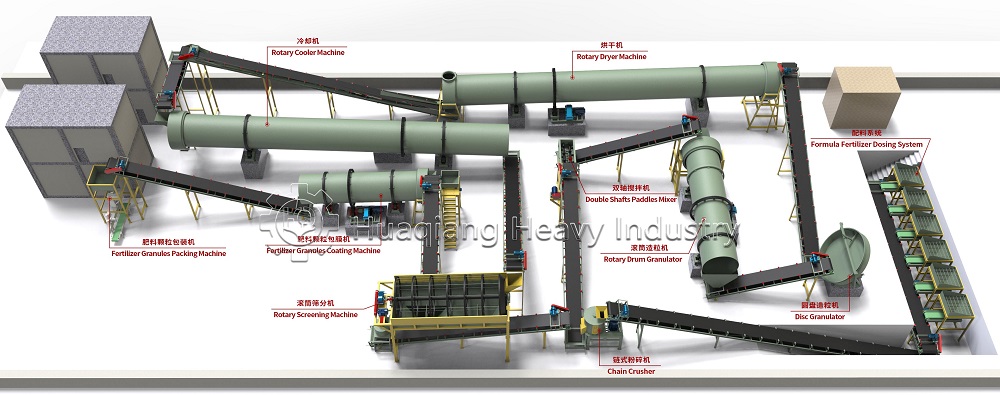
The disc granulator machine remains an indispensable platform within the broader organic fertilizer granulator series, offering unmatched flexibility for small-batch, multi-variety production where spherical aesthetics and rapid formula switching are paramount. While a rotary drum granulator dominates high-throughput compound fertilizer operations through steam-assisted agglomeration, the disc granulator excels in scenarios demanding precise particle size control and low capital entry. Within a complete organic fertilizer disc granulation production line, disciplined management of disc inclination, rotation speed, spray volume, and feed uniformity transforms raw powder into 65–75% yield spherical pellets that flow seamlessly into downstream drying, cooling, and automatic fertilizer packaging machine stages. Mastery of this fertilizer production machine technology—evidenced by stable bearing temperatures, clean disc surfaces, and calibrated scraper gaps—ensures that the fertilizer granulator machine operates not merely as a mechanical mixer but as a precision spheronization engine, converting formulation expertise into consistently marketable, structurally robust granules.