
What is the core logic behind adapting a roller extrusion granulator to the 12-12-17 formula?
The 12-12-17 type nitrogen-phosphorus-potassium compound fertilizer refers to a medium-potassium high-concentration formula with nitrogen, phosphorus pentoxide, and potassium oxide contents of 12%, 12%, and 17%, respectively. This formula has a high proportion of potassium sources (usually potassium sulfate or potassium chloride), and the potassium salt crystals have high hardness, weak hygroscopicity, and poor self-adhesion, posing a unique challenge to the granulation process. The roller extrusion granulator, with its purely physical dry forming principle, has become the most cost-effective granulation solution for the 12-12-17 formula.
Raw Material Pretreatment: Dual Control of Hardness and Fineness
The high proportion of potassium salts (potassium sulfate or potassium chloride) in the 12-12-17 formula has a Mohs hardness of 2.5 to 3.0, far exceeding that of urea (1.5) and monoammonium phosphate (2.0). Insufficiently crushed potassium salt coarse crystals are prone to stress concentration between the rollers, leading to surface cracks or molding failure. Before entering the machine, the raw material must be pulverized by a Raymond mill or ring roller mill, with a fineness requirement of 98% passing through a 100-mesh sieve (particle size below 0.15 mm), which is more stringent than the 80-mesh standard for conventional NPK formulations. Simultaneously, because potassium salts have much lower hygroscopicity than urea, the overall critical relative humidity of the formulation is relatively high (approximately 65% to 70%), and the raw material moisture content can be relaxed to the range of 8% to 12%, resulting in better storage stability than high-nitrogen formulations. However, when the moisture content exceeds 15%, the potassium salt surface dissolves and recrystallizes, causing it to stick to the rollers, requiring pre-drying or the addition of 0.5% to 1% of a hydrophobic anti-caking agent.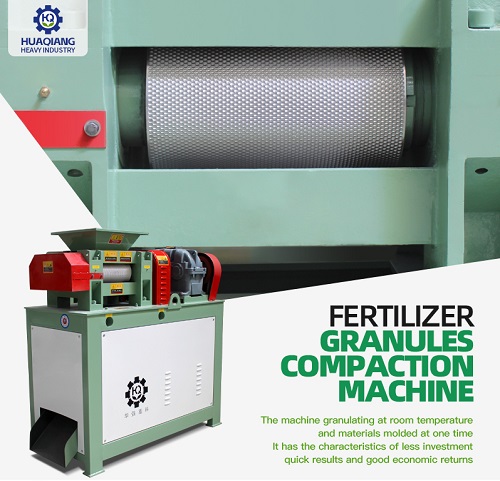
Roller Parameters: Precise Matching of Pressure and Gap
Due to the high potassium salt content, the 12-12-17 formulation requires approximately 20% to 30% higher molding pressure than the conventional 15-15-15 formulation. The linear pressure of the double-roll extrusion granulator should be set between 200 and 280 MPa. Under this pressure, the lifespan of conventional alloy rolls processing 12-12-17 formulations is approximately 50% to 60% of that used for urea-based formulations. It is recommended to use tungsten carbide welded rolls or solid carbide rolls to extend the single replacement cycle from 800 hours to over 1500 hours. The roll gap should be controlled between 0.8 and 1.5 mm. Too small a gap will cause current spikes and equipment overload, while too large a gap will result in insufficient sheet thickness and reduced particle strength after crushing. Considering the hardness characteristics of potassium salts, a two-stage double-roll structure of “pre-compression + main compression” is recommended—the first stage pre-compresses the material at a lower pressure (120 MPa) to densify it, and the second stage uses high pressure (250 MPa) for final shaping, which can reduce main roll wear by approximately 35%.
Crushing and Granulation: Quality Shaping of Angular Particles After crushing and granulation, the 12-12-17 formulation particles produced by roller extrusion are irregularly shaped polyhedrals or lentils, with a compressive strength of 18 to 28 Newtons, higher than the 15 to 20 Newtons of roller-granulated products with the same formulation. However, the high-potassium formulation particles are slightly more brittle, so the hammer speed of the crusher and granulator needs to be reduced from the conventional 800 rpm to 600 to 700 rpm to reduce the generation of fine powder due to impact crushing. The screening process uses a double-layer vibrating screen, with an upper screen aperture of 3.5 mm and a lower screen aperture of 1.8 mm, controlling the proportion of finished particles with a diameter of 2 to 4 mm to be above 85%. The undersize fine powder is mixed with virgin material at a return ratio of 0.4:1 to 0.6:1 for reuse. The potassium salt microcrystals in the fine powder can serve as nucleation sites, increasing the secondary granulation rate by 3 to 5 percentage points.
Engineering High-Potassium Formulations Through Dry Compaction
The successful adaptation of roller extrusion technology to the 12-12-17 formula demonstrates how advanced fertilizer production machine technology can overcome the inherent challenges of high-potassium, low-adhesion raw materials. By deploying a double roller extrusion granulator with tungsten carbide welded rolls operating at 200–280 MPa within a roller press granulator production line, manufacturers achieve dense, angular pellets with compressive strength of 18–28 Newtons—substantially exceeding steam-granulated equivalents—while eliminating the fuel-intensive drying stage entirely. This fertilizer granules compaction approach, executed through a precision-calibrated fertilizer compactor, transforms potassium sulfate and chloride crystals into durable, market-ready granules without chemical binders or thermal degradation. When integrated into a broader npk fertilizer production line, the dry-process route not only reduces energy consumption by 80–90% relative to wet granulation but also delivers superior storage stability and handling properties. Ultimately, the 12-12-17 case validates that with disciplined raw material pretreatment, wear-resistant tooling, and staged pressure architecture, roller extrusion stands as the most economically and technically rational granulation platform for high-hardness, low-hygroscopicity compound fertilizer formulations.