
What are large wheel compost turners and trough-type compost turners?
Large wheel compost turners utilize large wheel composting technology, with the equipment moving above the material pile and turning it using a rotating wheel. trough-type compost turners, on the other hand, require the pre-construction of concrete or brick fermentation troughs, with the equipment running along tracks above the trough. Both are mainstream equipment for aerobic fermentation, but their applicable scenarios and cost structures differ significantly.
Comparison of Processing Capacity and Footprint Efficiency: A large wheel compost turner can achieve a single turning width of 5 to 8 meters, processing 100 to 200 tons per hour, which is 2 to 3 times that of a trench compost turner. trough-type compost turners are limited by the width of the trough (usually 3 to 6 meters), resulting in a narrower single-operation width. In terms of footprint, the large wheel composting solution eliminates the need for fermentation trough walls, increasing site utilization by approximately 30%; however, large wheel piles require a 3 to 5-meter spacing between piles, while the trench composting solution allows for the close arrangement of multiple fermentation troughs. In summary, large wheel compost turners are more suitable for large-scale facilities with relatively abundant land, while trough compost turners are better suited for scenarios with limited land and strict odor control requirements.
Differences in Investment and Operating Costs: The main advantage of large wheel compost turners lies in their low civil engineering investment—only ground hardening is required, with equipment purchase costs ranging from $30,000 to $60,000 (for a 20-ton-per-day configuration). While trough compost turners have a slightly lower unit price, they require additional investment in concrete trough construction, with civil engineering costs typically accounting for 50% to 80% of the equipment price. In terms of operating costs, large wheel compost turners have a high degree of automation, allowing one worker to manage multiple stacks, reducing labor costs by 50% to 70% compared to trough compost turners. However, large wheel compost turners face greater difficulty in controlling moisture content during open-air operation in the rainy season, while trough compost turners, with their rain shelters, are better able to maintain a stable fermentation environment.
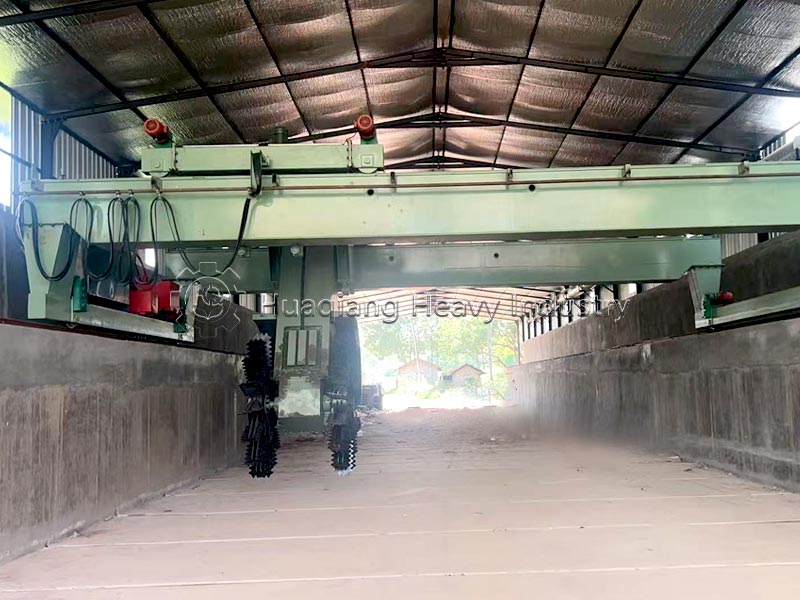
Applicable Scale Assessment: For daily processing of 10 to 30 tons of organic waste, trough compost turners offer better overall cost-effectiveness. For daily processing of over 30 tons with ample land, the unit processing cost of large wheel compost turners decreases significantly with increasing scale. For projects with stringent environmental rating requirements or located near residential areas, we recommend prioritizing trough-type fermentation with a corresponding deodorization system.
The choice between large wheel and trough-type compost turners is ultimately a strategic decision about capital efficiency, land use, and environmental compliance—but its impact extends far beyond the fermentation stage into every downstream unit of a modern bio organic fertilizer production line. Once stabilized compost exits the turner, it enters a refined processing train where fertilizer screening equipment removes oversized debris and undecomposed fibers, ensuring only uniform material reaches the organic fertilizer disc granulator or alternative fertilizer granulator machine for pelletization. The spherical pellets produced by disc granulation offer superior marketability and mechanical handling properties, while the fertilizer dryer and cooler stabilizes moisture below 15% and temperature below 40°C to prevent storage degradation and microbial reactivation. Finally, the automatic fertilizer packing machine delivers sealed, accurately weighed bags ready for distribution. Whether the upstream fermentation relies on open-field wheel turning or enclosed trough systems with deodorization, the downstream value-adding sequence—screening, granulation, drying, cooling, and packaging—remains the critical path that transforms decomposed waste into a premium, shelf-stable commercial product. By aligning turner selection with the scale and sophistication of downstream equipment, producers ensure that fermentation output quality directly translates into granulation efficiency, drying energy savings, and packaging throughput.
We offer both large wheel compost turner and trough-type turning equipment, and can provide free investment comparison plans and five-year operating cost estimates based on your daily processing capacity, land conditions, and environmental rating, helping you find the optimal balance between cost, efficiency, and compliance.