
Standard Procedures for Raw Material Pre-treatment: Although large wheel compost turning machines possess powerful turning capabilities, raw material pre-treatment is still indispensable. Fresh manure such as chicken and pig manure requires solid-liquid separation to reduce the moisture content from over 80% to below 70%. Corn stalks, wheat straw, and other straws need to be crushed to 10-20 cm in length using a shredder; excessive length will affect the uniformity of turning, while insufficient length will reduce the permeability of the pile. Industrial waste such as distiller’s grains and medicinal residues require manual removal of impurities such as metal and plastic. During the batching process, the carbon-to-nitrogen ratio needs to be adjusted to between 25 and 30:1; a too-high carbon-to-nitrogen ratio slows down fermentation temperature rise, while a too-low ratio results in significant ammonia loss.
Operating Parameters for Pile Construction and Turning: The cross-section of the windrows is trapezoidal or triangular, with a base width of 5-8 meters, a top width of 1.5-2.5 meters, and a height of 1.5-2 meters. The pile length can be flexibly determined according to the site conditions, typically 50-100 meters. The spacing between piles is 3 to 5 meters to ensure sufficient space for equipment passage while avoiding interference between adjacent piles. The initial turning is performed when the pile temperature reaches 50 to 60 degrees Celsius, typically on the 1st to 3rd day after pile construction. During the high-temperature period, turning is done every 2 days, for a total of 3 to 4 times. During the cooling period, turning is done every 3 to 4 days, for a total of 2 to 3 times. After each turning, the material is completely rotated from top to bottom of the pile to ensure uniform fermentation.
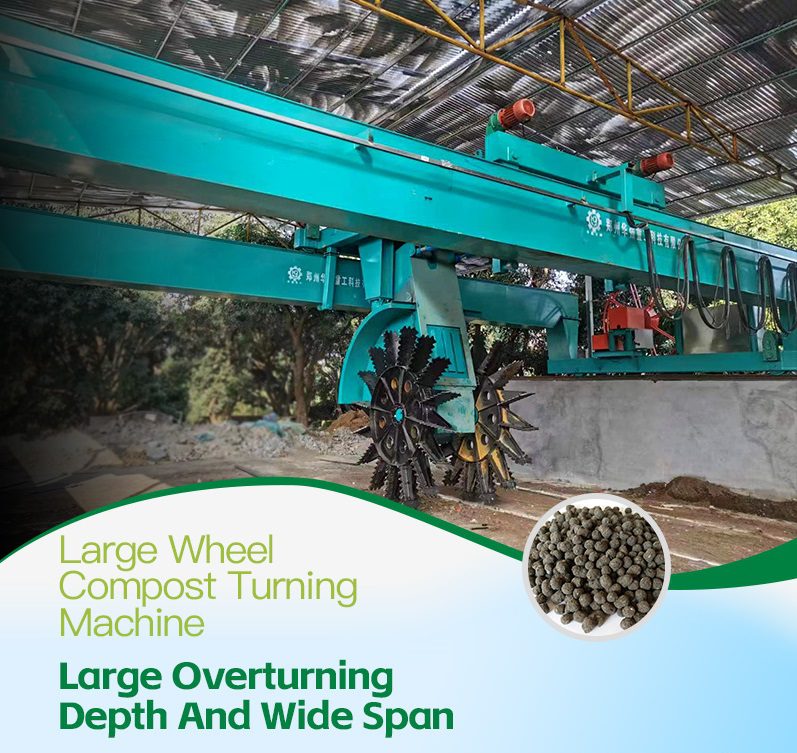
Production Line Integration and Continuous Production
In organic fertilizer production lines with an annual output of over 100,000 tons, the rotary turner can achieve continuous production through multi-pile rotation: one pile receives new material for initial fermentation, one pile is in the high-temperature period, and one pile is in the cooling and maturation period. The equipment operates sequentially between piles according to a fixed cycle, with a daily processing capacity of 800 to 1500 tons. The matured material is then transported by a loader to subsequent crushing, screening, and granulation processes, forming a complete pretreatment-large-scale fermentation-deep processing production chain.
Orchestrating Continuous Fermentation at Industrial Scale
The integration of a large wheel compost turning machine into a high-capacity organic fertilizer operation transforms discrete batch fermentation into a continuous, pipeline-style biological conversion system. Through disciplined fermentation composting turning technology—including precise raw material pretreatment, controlled windrow geometry, and phased turning protocols—this compost turner machine achieves daily throughputs of 800 to 1,500 tons while maintaining thermophilic stability across the entire composting process for animal manure. Whether processing nitrogen-dense poultry litter through a dedicated chicken manure fertilizer machine workflow or managing mixed livestock waste via a versatile animal manure compost turner, the multi-pile rotation strategy ensures that initial fermentation, high-temperature decomposition, and cooling maturation proceed in parallel without interruption. Once stabilized, the matured compost feeds seamlessly into downstream crushing, screening, and granulation stages, completing the fertilizer production process from waste reception to marketable product. Within the broader fertilizer manufacturing process, this fermentation stage also serves as a critical input for fertilizer chemical formula processing, where organic matter is blended with inorganic nutrients to create compound formulations. By synchronizing turning frequency with pile temperature profiles and linking fermentation output directly to material handling logistics, operators convert what was once a seasonal, weather-dependent activity into a year-round, industrially calibrated fertilizer production process that underpins both standalone organic fertilizer sales and integrated compound fertilizer manufacturing.
We provide large wheel compost turning machines and matching pre-treatment equipment, support multi-stack rotation continuous production scheme design, and can plan the layout of the fermentation zone and the daily processing rhythm free of charge according to your annual production scale, helping you achieve efficient assembly line operation from raw materials to mature materials.