
What is Commercial Vermicompost Organic Fertilizer?
Commercial vermicompost organic fertilizer refers to organic fertilizer produced by artificially raising specific species of earthworms (mainly Eisenia fetida), utilizing their excrement after consuming organic waste, and then collecting, screening, and processing it. Vermicompost contains abundant humic acid, beneficial microorganisms, and plant growth regulators, and its nutrient availability is significantly higher than traditional compost. Commercial production requires specialized equipment to achieve continuous operation from raw material pretreatment to finished product packaging.
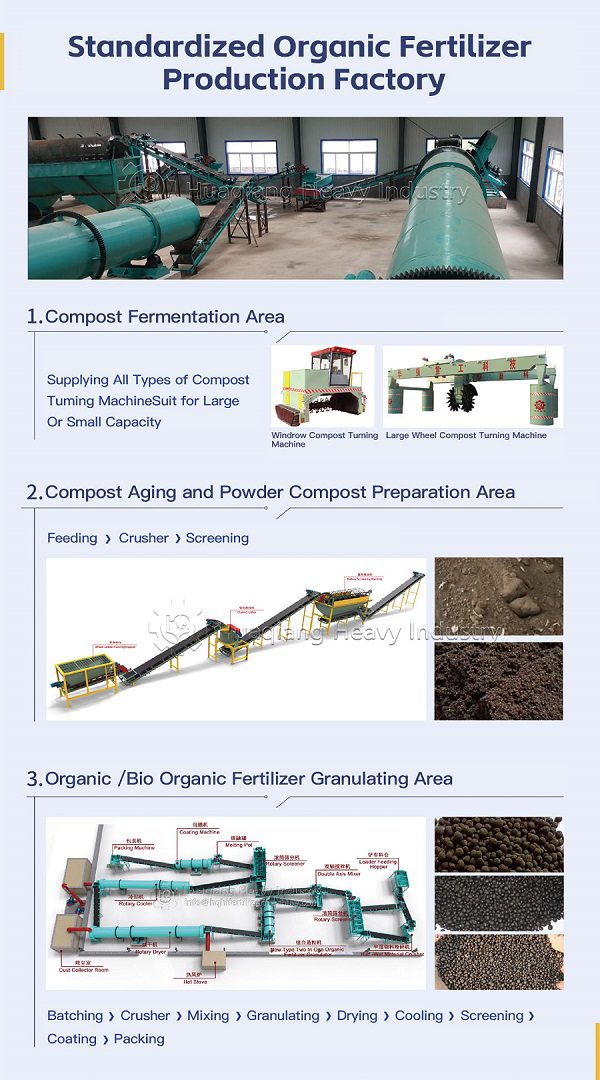
Raw Material Pretreatment: Preparation of Earthworm Feed
Earthworm feed mainly consists of well-rotted organic materials; fresh excrement cannot be fed directly. The pretreatment process involves mixing cow dung, sheep dung, or pig dung with straw at a carbon-to-nitrogen ratio of 25:1 to 30:1, adjusting the initial moisture content to 65% to 75%. The mixed material needs to undergo 10 to 15 days of pre-fermentation—this stage reduces the ammonia concentration in the material (ammonia is highly toxic to earthworms) through microbial action, while also killing some insect eggs. During pre-fermentation, the compost needs to be turned 2 to 3 times. Pre-treatment equipment includes: a solid-liquid separator (to reduce the moisture content of the raw materials), a straw shredder (cutting to 3 to 5 cm), and a double-shaft mixer (for uniformly mixing manure and auxiliary materials). For a production scale of 2 to 3 tons of vermicompost per hour, the equipment investment for the pre-treatment unit is approximately US$10,000 to US$20,000.
Breeding Bed System: The Earthworm’s Workshop The core facility for commercial earthworm farming is the breeding bed. A long, narrow bed design, similar to those used in greenhouses, is adopted: 1.0 to 1.5 meters wide, 0.3 to 0.4 meters high, and the length can be extended to 30 to 50 meters depending on the site. The bed is surrounded by cement bricks or anti-corrosion wooden boards, and a 15 to 20 cm layer of pre-fermented material is laid at the bottom as a habitat substrate for the earthworms. The stocking density is 0.5 to 1 kg of earthworms per square meter (approximately 2000 to 4000 worms). Shading nets and sprinkler systems are installed above the beds to maintain an internal temperature of 18-25 degrees Celsius and a moisture content of 70-80%. Earthworm castings can be harvested every 30-45 days, yielding 0.4-0.6 tons of castings per ton of raw material, while simultaneously increasing earthworm biomass by 3-5 times. Large-scale commercial facilities utilize multi-layer bed frame structures (3-5 layers), improving land use efficiency by 2-3 times.
III. Earthworm Separation Equipment: The Key to Castor Casing Separation
Separating earthworms from castings during harvesting is a technical bottleneck in commercial production. A common solution is vibrating screening: the material from the breeding bed is shoveled into a drum screen or linear vibrating screen with a mesh size of 3-6 mm. Earthworms, due to their body length, cannot pass through the screen and are thus separated, while the castings fall below the screen and are collected. After screening, the earthworms can be returned to newly fed breeding beds for continued use. For a production scale of 1 to 2 tons per hour, a double-layer vibrating screen is recommended—the upper screen with 6 mm apertures separates earthworms and large debris, while the lower screen with 2 mm apertures removes fine powder impurities. The vibrating screen has a processing capacity of 2 to 5 tons per hour, with an equipment investment of approximately US$3,000 to US$8,000. Photocatalytic separation and wet separation are used in other industries, but are less common in commercial earthworm casting production due to efficiency issues.
- Screening and Further Processing: Upgrading the Quality of the Finished Product The separated earthworm castings require further processing before they can be sold as commercial fertilizer. First, a drum screen (2 to 4 mm apertures) removes residual undecomposed fibers and eggshells. If granular products are required, the product enters the granulation stage—a double-roller extrusion granulator is the preferred option because it requires no binder and uses low-temperature molding, preserving the active substances in the earthworm castings. The extruded granules do not need drying (earthworm castings have a moisture content of approximately 40% to 50% when exiting the screen; the granules can be packaged after slight drying) and are directly fed into an automatic packaging scale. To extend shelf life, a low-temperature belt dryer (temperature below 60 degrees Celsius) can be configured to reduce moisture content to below 25%. The investment for a deep processing unit is approximately US$10,000 to US$30,000, depending on whether granulation and drying are included.
- Environmental Control and Auxiliary Systems Earthworms are highly sensitive to temperature, humidity, and pH levels. An environmental control system is essential for commercial-scale production. Greenhouses need to be equipped with an automatic sprinkler system (humidity sensor controlled to maintain 70% to 80% relative humidity), ventilation fans (for cooling in summer and insulation in winter), and shade nets (to avoid direct sunlight, as earthworms are photophobic). In cold winter regions, underfloor heating or hot air furnaces are required to maintain the bed temperature above 15 degrees Celsius. Auxiliary equipment also includes: forklifts (for material transfer and feeding), conveyor belts (connecting pretreatment, rearing beds, and screening processes), and basic laboratory equipment (for periodically monitoring material pH, ammonia nitrogen concentration, and earthworm health).
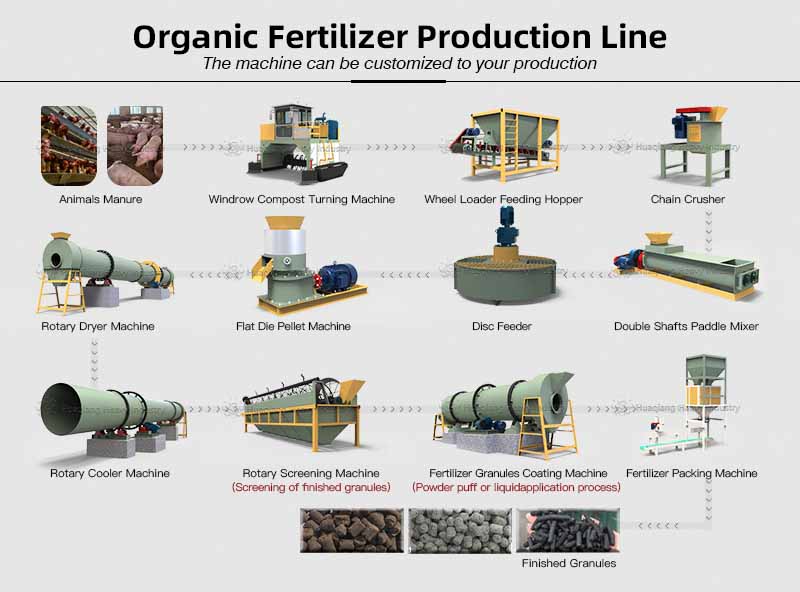
Production Capacity and Investment Reference: A small-scale commercial line producing 500 tons of vermicompost annually (processing 2 tons of raw materials per day): Equipment investment approximately US$20,000 to US$40,000, requiring 300 to 500 square meters of space (single-layer breeding beds). A medium-scale line producing 2,000 tons annually (processing 8 tons of raw materials per day): Equipment investment US$80,000 to US$150,000, using double or multi-layer breeding beds, requiring 800 to 1,200 square meters of space. Large-scale projects with an annual production capacity of over 5,000 tons are recommended to include automated feeding and harvesting systems, requiring an investment of over US$300,000. The final selling price of vermicompost is typically 2 to 3 times that of ordinary organic fertilizer (US$200 to US$400 per ton), and the investment payback period is generally 2 to 4 years.
From Earthworm Biology to Industrial Vermicompost Value
Commercial vermicompost production transcends simple waste recycling—it is a biologically intensive manufacturing discipline where earthworm physiology, environmental control, and mechanical efficiency converge. The Vermicompost organic fertilizer production process begins with precise feedstock conditioning, where an Animal manure processing machine—including solid-liquid separators, straw shredders, and double-shaft mixers—transforms raw livestock waste into earthworm-safe substrate with optimal C:N ratios and moisture profiles. The Vermicompost composting machine ecosystem, comprising multi-layer breeding beds with automated sprinkler and climate control systems, creates the stable 18–25°C microenvironment that maximizes casting yield and earthworm biomass proliferation. Post-harvest, vibrating screens and low-temperature extrusion granulators complete the transformation from biological excrement to premium granular fertilizer, with optional fertilizer drying and cooling machine units extending shelf life without compromising microbial viability. For entrepreneurs evaluating entry into this high-margin sector, organic fertilizer equipment price must be weighed against the 2–3× price premium that vermicompost commands over conventional compost. Whether deploying a compact organic fertilizer machine suite for 500-ton annual output or scaling to a full organic fertilizer manufacturing plant exceeding 5,000 tons, the decisive success factor lies not in equipment scale alone, but in the disciplined integration of biological knowledge with process engineering—ensuring that every ton of finished product retains the humic acid, beneficial microbes, and growth regulators that define vermicompost’s superior agronomic value.