
What is the drying temperature of organic fertilizer granules?
The drying temperature of organic fertilizer granules refers to the range of hot air temperature and material temperature controlled during the drying process after organic fertilizer granulation, when excess moisture is removed from the granules using drying equipment. This parameter directly affects drying efficiency, organic matter retention rate, microbial survival rate, and the appearance quality of the finished product. Unlike chemical fertilizers, organic fertilizers contain a large number of heat-sensitive components—humic acid begins to decompose above 120 degrees Celsius, and beneficial microorganisms die in large numbers above 70 degrees Celsius.
Temperature Tolerance Boundaries for Different Raw Materials
The compositional differences of organic fertilizer raw materials determine the upper limit of the drying temperature. For pure livestock and poultry manure-based organic fertilizers (such as chicken manure and cow manure fermented and decomposed before granulation), it is recommended to control the inlet hot air temperature of the dryer at 150 to 200 degrees Celsius, and the outlet material temperature not exceeding 55 to 60 degrees Celsius. These materials have an organic matter content of approximately 40% to 60% and moderate heat sensitivity. Organic fertilizers made primarily of straw, due to their high cellulose content and poor thermal conductivity, can have their inlet hot air temperature slightly increased to 180-230 degrees Celsius. However, the outlet material temperature must still be controlled below 60 degrees Celsius to prevent fiber carbonization and blackening. Bio-organic fertilizers with added microbial agents are most sensitive to temperature—the inlet hot air temperature must not exceed 120 degrees Celsius; a low-temperature, long-duration drying scheme of 80-100 degrees Celsius is recommended, and the outlet material temperature should be below 45 degrees Celsius to ensure a functional bacteria survival rate of over 70%.
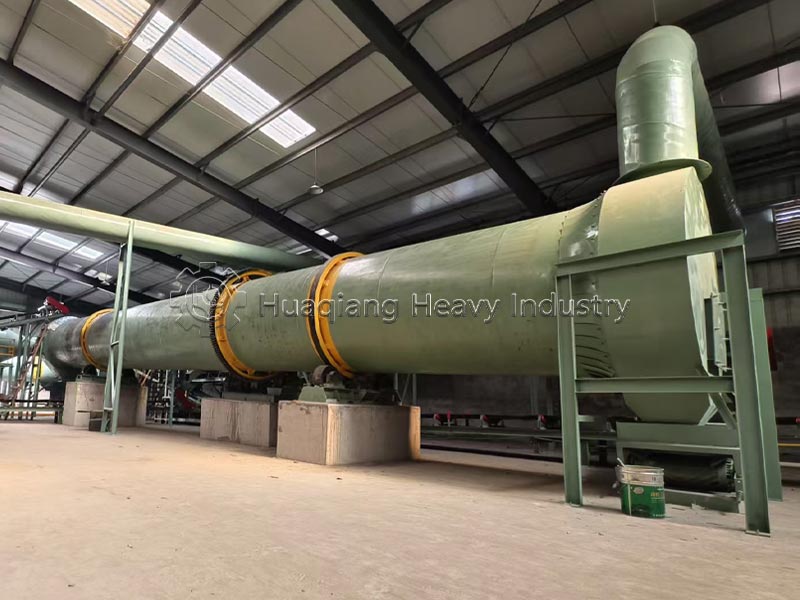
Temperature Zone Configuration of Drying Equipment Different drying equipment varies significantly in thermal efficiency and temperature control capabilities. Rotary drying drums are the most widely used equipment in the organic fertilizer industry. Their inlet hot air temperature is typically set between 150 and 300 degrees Celsius, controlled by adjusting the burner power and induced draft fan volume. A three-stage temperature control strategy is the industry-recommended practice: In the preheating stage, the material is heated to 40-50 degrees Celsius, and surface moisture begins to evaporate; in the main drying stage, the material temperature is raised to 55-65 degrees Celsius, removing most of the internal moisture; in the cooling stage, ambient air is used to cool the material to below 40 degrees Celsius to prevent condensation after packaging. This segmented control can keep organic matter loss below 5%.
Low-temperature belt dryers are specifically designed for heat-sensitive materials. The hot air temperature is controlled at 60-80 degrees Celsius throughout the process, and the material moves slowly on a multi-layer mesh belt with a residence time of 60-120 minutes. The organic matter retention rate after drying can reach over 95%, making it suitable for bio-organic fertilizers or products with high humic acid content. However, the equipment investment is approximately 1.5 to 2 times that of a rotary dryer with the same capacity, and energy consumption is 15% to 25% higher.
Fluidized bed dryers are suitable for granules that have already reached a certain strength. The inlet air temperature is 80-120 degrees Celsius, and the bed material temperature is 40-60 degrees Celsius. Its drying efficiency is high and the residence time is short (5 to 15 minutes), but it requires high mechanical strength of the granules—the compressive strength of organic fertilizer granules must reach at least 8 Newtons, otherwise they are prone to pulverization during fluidization.
III. Moisture Control and Temperature Linkage The drying endpoint for organic fertilizer granules is when the finished product moisture content drops to 15% to 20% (the organic fertilizer industry standard requires no higher than 20%). There is a linkage between drying temperature and feed moisture content, as well as granule size. For every 5 percentage point decrease in feed moisture content, the required drying temperature can be lowered by 15 to 20 degrees Celsius, or the drying time shortened by 20% to 25%. Therefore, strengthening pre-drying after granulation (such as extending the natural air-drying time on the conveyor belt) is an effective way to reduce the drying temperature.
For every 1 mm increase in granule size, the path for internal moisture to migrate to the surface is lengthened, and the required drying time increases by approximately 30% to 40%. For organic fertilizer granules of 4 to 6 mm, a “medium-temperature slow drying” strategy is recommended—an inlet temperature of 180 to 200 degrees Celsius and a drum rotation speed of 3 to 5 revolutions per minute (30% lower than conventional granulators), extending the material’s residence time in the drum to 20 to 30 minutes. In this mode, the granule surface will not harden and crack due to rapid water loss, and internal moisture has sufficient time to diffuse to the surface for evaporation, controlling the crack rate of the finished granules to below 2%.
Typical consequences of temperature deviation: If the drying temperature is too low (inlet temperature below 120 degrees Celsius), even with extended residence time, it is difficult to completely remove internal moisture from the granules, making them prone to mold growth after packaging. If the drying temperature is too high (inlet temperature exceeding 300 degrees Celsius) and the outlet material temperature exceeds 70 degrees Celsius, the organic fertilizer will exhibit three types of deterioration: surface carbonization and blackening, a decrease in organic matter content of 8 to 15 percentage points, and increased ammonia odor (due to the pyrolysis of nitrogenous organic matter producing free ammonia). A more hidden risk is that when the temperature is too high but the residence time is insufficient, the surface of the granules may be dry while the inside remains moist. After packaging, moisture will migrate outwards during storage and transportation, leading to clumping and mold growth. It is recommended to sample and test the material temperature and moisture content at the dryer outlet for each batch of production, and establish a temperature-residence time comparison table for specific formulations.
From Fermentation to Drying, a Temperature-Calibrated Value Chain
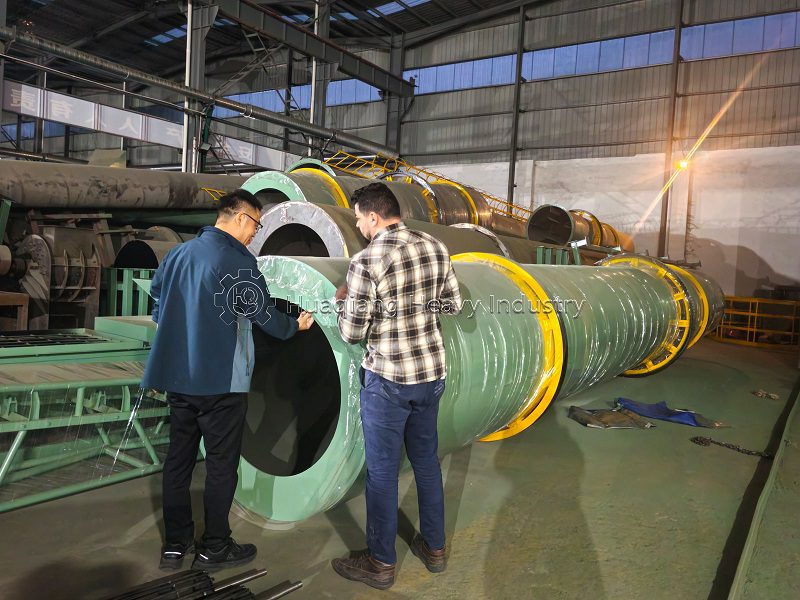
Mastering the drying temperature of organic fertilizer granules is not an isolated thermal exercise but the culminating discipline of a carefully orchestrated production sequence. The journey begins in the organic fertilizer fermentation process, where a windrow composting machine or trough turner drives aerobic decomposition to stabilize raw material moisture and pathogen loads before granulation. Once pellets are formed, the fertilizer dryer machine becomes the critical guardian of product quality—its three-stage temperature configuration (preheating, main drying, cooling) must be precisely calibrated to raw material heat sensitivity, whether processing livestock manure, straw-dominant blends, or bio-organic formulations with live microbial inoculants. For emerging producers, a small scale organic fertilizer plant equipped with entry-level organic fertilizer machine units can achieve sub-20% moisture targets using rotary drum dryers with segmented burner control, while larger organic fertilizer manufacturing plant facilities may invest in belt dryers for >95% organic matter retention. The integrated fertilizer dryer and cooler train, when synchronized with upstream fermentation parameters and downstream packaging protocols, transforms temperature management from a damage-prevention necessity into a competitive differentiator that preserves microbial viability, prevents carbonization, and extends shelf stability. Balancing organic fertilizer equipment price against thermal precision ultimately determines whether a production line merely processes waste or consistently delivers premium-grade soil amendments.
We offer rotary drying drums and low-temperature belt dryers, and can customize three-stage temperature control schemes and moisture-temperature linkage parameters free of charge according to your raw material organic matter content and microbial agent addition requirements, helping you achieve a precise balance between drying efficiency and nutrient retention.