
What is a Double Roller Extrusion Granulator?
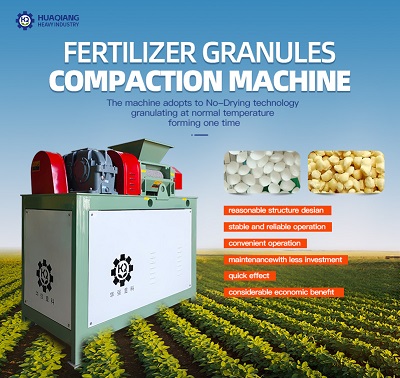
A double roller extrusion granulator is a dry granulation equipment that uses two counter-rotating rollers to force powdered materials into flakes or strips, which are then crushed and granulated into pellets. Unlike wet processes such as disc granulation and drum granulation, the double roller extrusion process does not require the addition of water or binders; it relies on pure physical pressure to re-agglomerate the material particles.
I. Waterless Drying, Directly Reduced Energy Consumption
Wet granulation processes require the addition of 15% to 25% moisture to the material before granulation to promote agglomeration. After granulation, the moisture content must be reduced to below the target value through thermal drying. This drying process typically consumes more than 60% of the energy of the entire production line. Double roller extrusion granulators use a dry process, requiring only 8% to 12% moisture content in the raw materials. After granulation, no further drying is needed before directly entering the screening and packaging stage. According to process comparison data, under the same capacity conditions, the overall energy consumption of double roller extrusion granulation is 40% to 50% lower than that of wet processes.
II. High Particle Strength and Low Powdering Rate During extrusion molding, material particles are compacted under a linear pressure of 150 to 300 MPa, forming a dense crystalline structure within the particles. This physical bonding force is far stronger than the capillary bridging formed after water evaporation in wet processes. The compressive strength of the finished particles can reach 15 to 30 Newtons, which is 2 to 3 times that of disc granulation products. High strength means a significantly reduced powdering rate during packaging, transportation, and field application—typically controlled to within 3%, while the powdering rate of wet-process spherical particles is usually in the range of 8% to 12%.
III. No Binders Required, Retaining Pure Components Wet granulation processes often require the addition of binders such as bentonite and lignin sulfonates to assist in pellet formation; these additives account for 3% to 8% of the total mass of the finished product. Roller extrusion granulation relies entirely on mechanical pressure molding, requiring no chemical additives. This is particularly important for the production of pure organic fertilizer or high-concentration compound fertilizer—the extra effective components per ton of finished product directly translate into economic benefits. Meanwhile, binder-free granules disintegrate faster in paddy fields, and their nutrient release curves better match the absorption rhythms of crops like rice.
IV. Wide Range of Raw Material Adaptability Roller extrusion granulation offers greater tolerance for the physical properties of raw materials. Processable materials include: fermented and decomposed organic fertilizer powder, mixtures of urea and easily soluble fertilizers such as potassium chloride, and mineral raw materials such as humic acid and bentonite. Regarding moisture content, stable production is possible within a wide range of 5% to 15%, significantly superior to disc granulators (which require a narrow window of 30% to 35%). For highly hygroscopic raw materials such as urea-based compound fertilizers, roller extrusion granulation is the only feasible dry process.
V. Compact Footprint and Simplified Process A complete roller extrusion granulation line requires only: a crusher, a roller extruder, a crusher and granulator, a screening machine, and a packaging scale. Compared to the heavy equipment required for wet processes, such as steam boilers, drying cylinders, cooling cylinders, and dust collection towers, the dry process reduces the number of equipment by approximately 40% and the floor space by more than half. This offers significant advantages for renovation and expansion projects with limited factory space or containerized mobile production units.
VI. Simple Operation and Quick Start-up: Wet granulation processes require operators to adjust multiple parameters in real time, such as water addition, steam pressure, roller inclination angle, and rotation speed, based on variables like raw material moisture, temperature, and viscosity, making it highly experience-dependent. The main control parameters for roller extrusion granulation are only the roller gap (typically 0.5 to 3 mm) and roller speed, with fewer adjustment dimensions and a shorter learning curve. Production startup also eliminates the need to wait for boiler pressurization or drying drum preheating; qualified granules can be produced within 5 to 10 minutes after power is supplied and materials are fed.
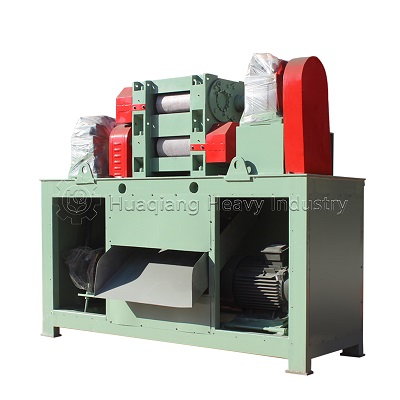
Applicable Scenarios: Roller extrusion granulators are particularly suitable for the following three scenarios: 1) Additive-free product lines requiring high organic matter content in organic fertilizer production; 2) Formulas with high hygroscopicity, such as high-nitrogen compound fertilizers, where wet granulation is difficult to stabilize; 3) Areas with unstable power supply or where environmental policies restrict boiler use. The granules are mostly irregular polygonal or lentil-shaped. Although their sphericity is lower than that of disc granulation products, their particle uniformity and mechanical strength are superior.
The double roller extrusion granulator represents a paradigm shift in fertilizer production machine technology, offering a compelling alternative to conventional wet-process routes. While a rotary drum granulator remains indispensable for applications demanding spherical aesthetics and steam-based agglomeration, the dry-process fertilizer compactor excels where energy efficiency, additive purity, and operational simplicity take precedence. By leveraging high-pressure fertilizer granules compaction at 150–300 MPa, this fertilizer compaction machine eliminates the thermal burden of drying, reduces equipment count by 40%, and delivers pellets with compressive strength 2–3 times higher than wet-process equivalents. When integrated into a modern npk fertilizer production line, fertilizer compaction technology not only lowers carbon footprint and capital expenditure but also unlocks formulation flexibility for hygroscopic and high-organic-matter blends that wet systems struggle to process. For manufacturers navigating tightening environmental regulations and volatile energy markets, adopting advanced compaction-based dry granulation is less a choice of equipment than a strategic reorientation toward sustainable, resilient fertilizer manufacturing.
We provide roller extrusion granulators and matching crushing and screening lines, supporting customized dry additive-free processes. We can also design compact, modular production solutions free of charge based on your raw material characteristics and site conditions, helping you achieve stable production of high-quality granules with lower energy consumption and a simpler process.