
In organic fertilizer production, transforming fermented and decomposed powdery materials into uniform granules is a crucial step in commercialization. Disc granulation production lines, with their high pelletizing rate, low energy consumption, and flexible operation, have become the mainstream choice for small and medium-sized organic fertilizer plants. This article analyzes the organic fertilizer production process and outlines the core equipment configuration for each stage.
What is an Organic Fertilizer Disc Granulation Production Line?
An organic fertilizer disc granulation production line refers to a complete equipment system that uses fermented and decomposed organic materials (such as chicken manure, cow manure, straw, and mushroom residue) as raw materials. Through continuous processes such as crushing, batching, mixing, disc granulation, drying, cooling, screening, and packaging, it transforms powdery materials into spherical granules. Its core equipment is the disc granulator, which relies on the rotation of the disc to roll and agglomerate the wet powder into granules.
Organic Fertilizer Raw Material Processing Equipment: From Waste to Qualified Powder
Organic fertilizer raw materials have complex characteristics—high moisture content, high fiber content, and a tendency to clump—making pre-treatment equipment crucial.
The half-wet material crusher is the core of the raw material processing stage. It is specifically designed for wet, sticky materials with a moisture content of 25%-55%, employing a two-stage rotor series connection and a screenless structure, completely solving the problem of screen clogging in traditional crushers. The material enters the upper rotor for coarse crushing and breaking up clumps, then enters the lower rotor for fine crushing to a fineness of 0.5-1.0mm. High-alloy forged hammer blades offer over 50% better wear resistance than ordinary hammers. Common models have power ratings ranging from 22-75kW and capacity from 1-8 tons/hour.
The horizontal twin-shaft mixer is responsible for uniformly mixing the crushed material with auxiliary materials (such as binders and trace elements). The counter-rotating blades of the twin shafts generate shear and convection, controlling the coefficient of variation (CV) of mixing uniformity to within 7%, with a mixing time of only 1.5-5 minutes.
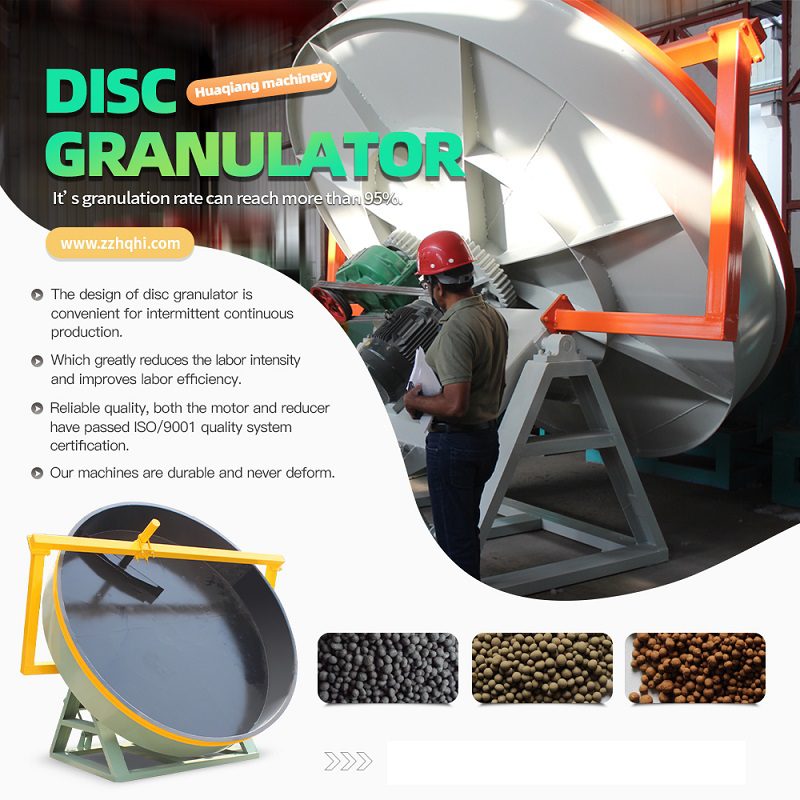
III. Organic Fertilizer Granulator Series: Disc Granulator Explained The disc granulator is a classic model in the organic fertilizer granulator series. It consists of a shallow, tilted disc and a drive unit. The disc’s tilt angle is adjustable from 35° to 55°, and the rotation speed is typically 15-25 rpm.
Its working principle is typical wet granulation: material is added to the disc from above, and while the disc rotates, it receives water or binder solution sprayed from atomizing nozzles. Under the combined action of centrifugal force, friction, and gravity, the moist fine powder adheres and compacts layer by layer, like a snowball, eventually growing into spherical granules. When the granules reach the set size, they are automatically discharged over the edge of the disc.
Taking a 3-meter diameter disc granulator as an example, the single-machine capacity can reach 1.5-3 tons/hour, with a pelletizing rate exceeding 93%, and the finished particle size can be flexibly adjusted within the range of 1-8mm. It adopts a non-powered scraper design, which can save approximately 15%-20% of energy.
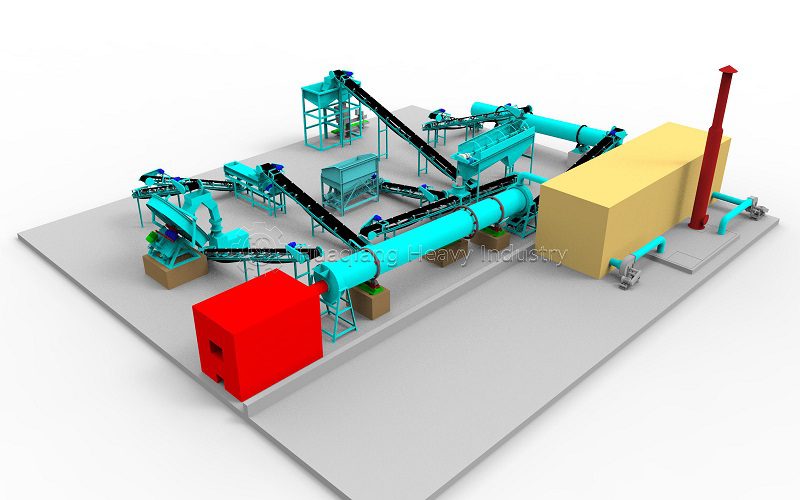
Complete Configuration of Organic Fertilizer Production Equipment
A complete disc granulation production line includes the following sequence of organic fertilizer production equipment:
Pre-treatment Section: A Half-wet material crusher crushes the fermented material to a suitable fineness; a batching system adds auxiliary materials according to the formula; a horizontal double-shaft mixer mixes the material and binder evenly.
Granulation Section: The disc granulator is the core equipment, combined with an atomizing spray system to control material humidity, achieving a pelleting rate of over 93%.
Post-treatment Section: A rotary dryer reduces the granule moisture content from 25%-30% to below 15%, controlling the inlet air temperature at 300℃-400℃; a rotary cooler reduces the granule temperature to below 40℃; a drum screener performs grading and screening; the finished product enters the packaging stage, and unqualified products are returned for regranulation; an automatic packaging scale completes quantitative filling and sealing.
Selection Recommendations: Equipment configuration must be precisely matched with raw material characteristics and production capacity targets. Before purchasing, take raw material samples for small-batch granulation testing to verify the pelleting rate and granule strength using measured data. This is a reliable method to avoid investment errors.