
Faced with the ever-increasing demands of large-scale agriculture, compound fertilizer manufacturers often face a dilemma: how to increase output while controlling energy consumption. The rotary drum granulation production line is a mature solution to this contradiction.
Core Technology: Rolling Granulation, Continuous Production
The secret of rotary drum granulation lies in a large, slightly tilted drum. As the drum rotates, the powdered material inside rubs and compresses against each other in a humid environment, gradually agglomerating into uniform granules like a snowball.
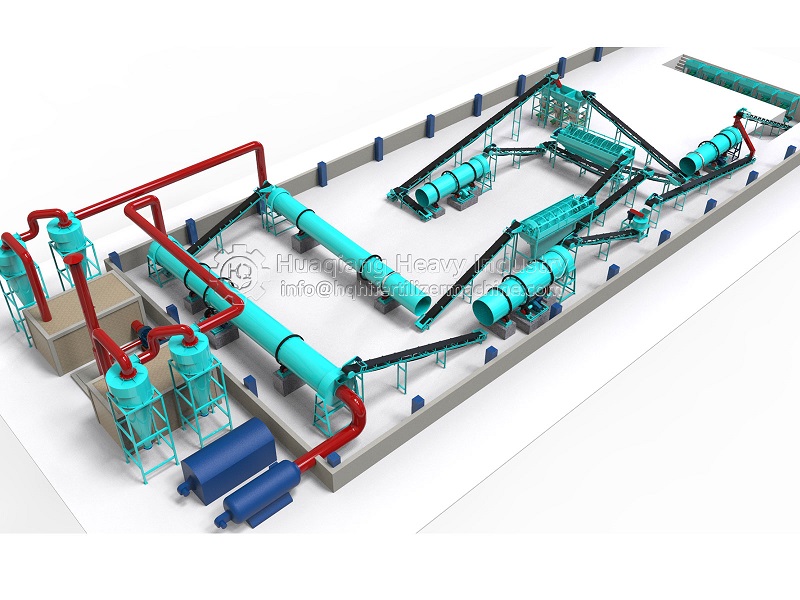
Standard automated processes include:
Precise Batching:Nitrogen, phosphorus, and potassium raw materials are automatically weighed according to the formula.
Mixing and Wetting:Appropriate amounts of steam or water are added to the drum to activate the material.
Rolling Granulation:The granule growth rate is controlled through precise adjustment of the drum’s rotation speed and angle.
Drying and Cooling:Hot air drying removes moisture, while cold air cooling prevents clumping.
Grading and Screening:Qualified granules are sent for packaging; oversized or undersized granules are returned for regranulation.
The entire process is continuous, taking only 20-30 minutes from powder to finished granules.
Core Equipment: Stability and Ease of Maintenance are Key
A high-efficiency rotary drum granulation line relies on three main pieces of equipment:
Drum Granulator: The drum body is made of corrosion-resistant steel and features a special lifting plate structure. This not only improves material rolling efficiency but also stabilizes the pelletizing rate at 85%-90%. Compared to disc granulators, it has a larger single-machine processing capacity and lower maintenance frequency—the bearings and transmission devices adopt a modular design, and daily maintenance only requires lubrication and checking liner wear.
Rotary Dryer and Cooler: Both have similar structures but different internal heat exchange plate designs. The heat source can be a coal-fired hot air furnace or a biomass burner, the latter being more environmentally friendly. The key is to control the feed temperature to not exceed 80℃ to prevent urea decomposition.
Automatic Screening Machine: Generally uses two or three layers of drum screens. Polyurethane material is recommended for the screens, as it is wear-resistant and not easily clogged.
Three Core Advantages
Compared to traditional granulation methods, this production line offers significant benefits:
High pelletizing rate and low waste: The primary pelletizing rate can reach 70%-80%, and with the recycling system for both over- and under-screen materials, the total utilization rate is close to 100%, with virtually no waste.
Controllable energy consumption: Although a heat source is needed for drying, by recovering waste heat from flue gas to preheat the air, the overall energy consumption per ton of product can be reduced by 15%-20% compared to wet processes.
Wide range of raw material adaptability: From potassium chloride and ammonium sulfate to urea, ammonium phosphate, and even some organic materials, all can be added in proportion, making it ideal for producing high-concentration compound fertilizers.
Practical Recommendations
Before introducing a rotary drum granulation line, please clarify three points: target production capacity (common range 1-20 tons/hour), main raw material types, and heat source conditions (whether natural gas or biomass is available). It is recommended to choose a supplier that provides process simulation and on-site commissioning to ensure production capacity is achieved immediately upon commissioning. During daily operation, regularly checking the wear of the lifting plates and the cylinder seals can extend the equipment’s lifespan to 8-10 years.
The maturity of drum granulation technology positions the rotary drum granulator at the heart of every competitive npk fertilizer production line. By mastering npk fertilizer production technology through precise rotation speed, tilt angle, and steam dosing control, manufacturers achieve 85-90% pelletizing rates with 20-30 minute cycle times—metrics that alternative fertilizer compactor systems struggle to match for high-moisture formulations. A well-architected rotary drum granulation production line integrates continuous batching, rolling, drying, and screening into a seamless fertilizer production machine technology ecosystem, recovering waste heat to cut energy intensity by 15-20% while maintaining feed temperatures below 80°C to prevent urea thermal degradation. Whether processing ammonium phosphate, potassium chloride, or urea blends, the rotary drum’s material adaptability and modular bearing design deliver 8-10 year lifespans with minimal downtime. For operations seeking proven scalability from 1 to 20 tons/hour, investing in process-simulated, commission-ready rotary drum granulator infrastructure transforms the output-versus-energy dilemma from a trade-off into a synchronized competitive advantage.