
Organic fertilizer fermentation often encounters two major obstacles: slow fermentation speed, with materials remaining cold even after a month; and foul odors, drawing complaints from nearby residents. The key to solving these problems lies in one piece of equipment—the trough turner.
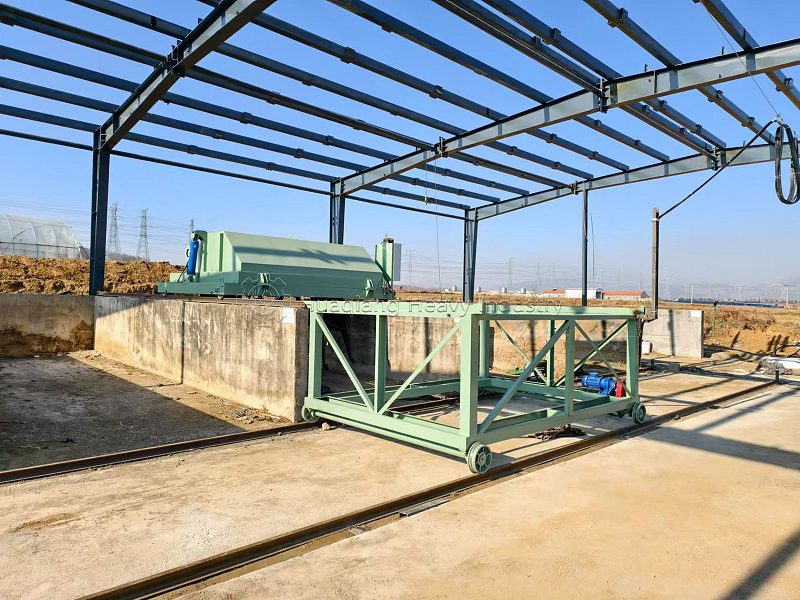
Three Core Functions of the Turner
The trough turner travels back and forth on the fermentation trough track, using rotating blades to break up, mix, and throw the materials backward. It simultaneously performs three key tasks:
- Forced Oxygen Supply, Activating Microorganisms
Aerobic fermentation requires sufficient oxygen. In a static pile of materials, oxygen deficiency allows anaerobic bacteria to dominate, producing foul odors such as hydrogen sulfide and ammonia. The turner thoroughly turns the materials every 1-2 days, restoring the oxygen content in the pores to over 15%, allowing thermophilic aerobic bacteria to once again dominate fermentation. The temperature then rises to 55℃-70℃, a temperature that rapidly decomposes organic matter and kills insect eggs and pathogens. 2. Uniform Temperature Control, Preventing Burning: Excessively high localized temperatures (above 75℃) can kill beneficial bacteria, halting fermentation. The turning machine mixes the outer layer of cold material with the inner layer of hot material, maintaining a temperature difference within ±5℃ throughout the fermentation tank. This ensures effective heat accumulation while preventing burning.
- Accelerated Dehydration, Reduced Drying Burden: Fresh manure typically has a moisture content exceeding 70%, while finished organic fertilizer requires ≤20%. Each turn of the turning machine evaporates 3-5% of the moisture with the heat. After 15-20 days of turning and fermentation, the moisture content of the material exiting the tank can be reduced to below 40%, significantly reducing energy consumption in subsequent drying stages. Wide Range of Applicable Raw Materials: The trough-type compost turner can process almost all organic waste:
Livestock and poultry manure: chicken manure, pig manure, cow manure, sheep manure (moisture adjustment required first)
Agricultural straw: corn stalks, rice husks, wheat straw (must be crushed to below 5cm)
Industrial organic waste residue: distiller’s grains, vinegar residue, mushroom residue, medicinal residue
Urban organic waste: kitchen waste, garden leaves
As long as the raw material has an organic matter content ≥30% and does not contain sharp hard objects (such as broken glass, metal fragments), it can be put into the fermentation tank for treatment.
III. Two Core Advantages: Short Cycle, Thorough Decomposition
The fermentation cycle is halved: Traditional natural composting takes 40-60 days and is not fully decomposed. The trough-type compost turner, combined with a forced ventilation system, can reduce the cycle to 15-20 days (summer) to 20-25 days (winter), with uniform decomposition.
Harmless treatment standards: The national standard NY/T 525-2021 requires that the mortality rate of roundworm eggs in organic fertilizer be ≥95% and the number of fecal coliforms be ≤100 CFU/g. Under conditions where the compost turner maintains a temperature above 55℃ for 5-7 consecutive days, these two indicators can be easily met. Simultaneously, ammonia and hydrogen sulfide emissions are reduced by approximately 70%, significantly improving the workshop working environment.
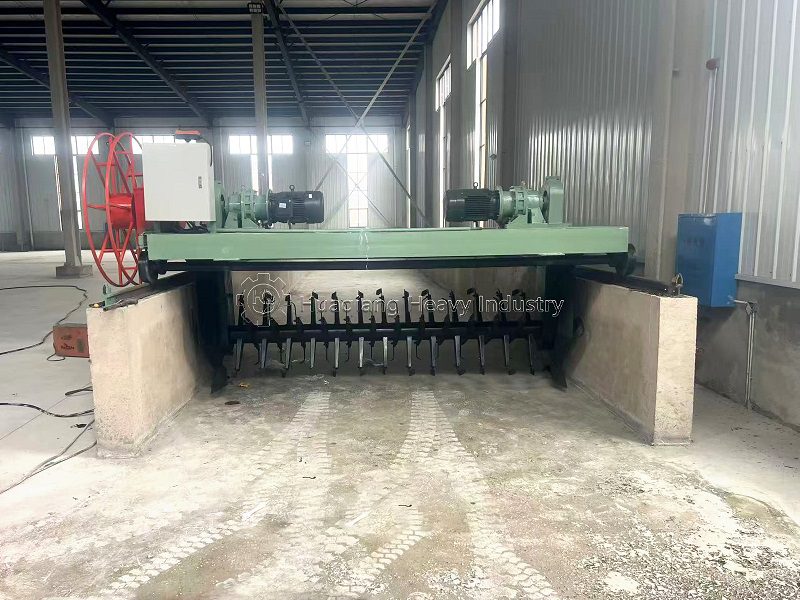
When selecting a trough-type compost turner, please pay attention to three parameters:
Single trough width: Commonly 2 meters, 3 meters, and 4 meters; must be matched with a loader or conveyor belt.
Turning depth: 0.8-1.5 meters; deeper troughs provide better insulation but require more motor power.
Walking drive: Hydraulic drive is more stable and suitable for sticky and wet materials; mechanical drive is easier to maintain and suitable for small and medium-sized farms.
During daily operation, it is recommended to record the temperature of the fermentation pile every 2 hours. If the temperature is below 50℃ for 24 consecutive hours, it indicates insufficient oxygen supply or an imbalance in the carbon-nitrogen ratio; the compost should be turned immediately and straw powder added. Additionally, leachate collection ditches should be installed at both ends of the fermentation tank to prevent the overflow of high-concentration wastewater. A good compost turner is both an “oxygen pump” for the fermentation workshop and a “purifier” for deodorization and pollution reduction. If you are troubled by slow fermentation and strong odor, you might as well start by upgrading your compost turner.
The trough turner, with its three core functions—forced oxygen supply, uniform temperature control, and accelerated dehydration—is an essential tool for addressing the common challenges of slow fermentation and strong odors. This equipment is a prime example of advanced fermentation composting turning technology. While a large wheel compost turner or windrow composting machine is suited for open-air windrows, the trough-type compost turner offers superior process control, making it the cornerstone of trough-type aerobic fermentation composting technology. A chain compost turning machine is another effective option for trough systems. These machines function as a highly efficient agriculture waste compost fermentation machine, transforming raw organic waste into stable, mature compost.
By maintaining a temperature above 55℃ for 5-7 consecutive days, the trough turner ensures that the final product meets national harmless standards (e.g., NY/T 525-2021) with a mortality rate of roundworm eggs ≥95% and fecal coliforms ≤100 CFU/g. The fermentation cycle is halved to 15-20 days, and moisture content is reduced to below 40%, significantly lowering energy consumption in subsequent drying stages. This mature compost then becomes the ideal feedstock for the fertilizer granulation technology stage, whether using a disc, drum, or roller press granulator.
Investing in a well-designed trough turner, with the correct parameters (trough width, turning depth, and hydraulic drive), is a strategic decision that accelerates production, reduces odors, and ensures a consistent, high-quality base material for your organic fertilizer line. For any producer struggling with slow fermentation or environmental compliance, upgrading to a trough-type aerobic fermentation composting technology system is a powerful first step toward efficient, sustainable, and profitable organic waste recycling.