
Basic Principles of Raw Material Selection
The core of bio-organic fertilizer lies in “organic matter + functional bacteria.” Therefore, there are two basic thresholds for raw material selection: organic matter content and restrictions on harmful substances. Suitable organic raw materials include livestock and poultry manure (chicken manure, cow manure, pig manure, sheep manure), agricultural straw (corn stalks, wheat stalks, soybean stalks), agricultural product processing by-products (soybean meal, rapeseed meal, tea residue, traditional Chinese medicine residue), and food industry waste (distillers’ grains, vinegar residue, sugar residue).
In raw material selection, it is important to avoid using livestock manure containing antibiotic residues. Long-term use of organic fertilizer containing antibiotics will damage the soil microbial ecology. Some antibiotics (such as tetracyclines) have a half-life of up to tens of days in the soil, posing a risk of absorption by crops. It is recommended to prioritize livestock manure that has undergone aerobic fermentation treatment, or to request the supplier to provide an antibiotic residue test report.
Adjustment of the Carbon-Nitrogen Ratio (C/N)
Microbial fermentation requires both carbon and nitrogen nutrients. The ideal carbon-nitrogen ratio is 25:1 to 30:1. A high carbon-to-nitrogen ratio (C/N ratio) (e.g., using straw alone) leads to nitrogen deficiency in microorganisms, resulting in slow fermentation and difficulty in raising the temperature. A low C/N ratio (e.g., using chicken manure alone) causes excess nitrogen to volatilize as ammonia, resulting in nutrient loss and odor pollution. Common C/N ratios for raw materials are as follows: chicken manure approximately 10:1, cow manure approximately 20:1, pig manure approximately 13:1, corn stalks approximately 60:1, rice husks approximately 70:1, and soybean meal approximately 6:1.
For example, using chicken manure (C/N=10) mixed with corn stalks (C/N=60), to adjust to a ratio of 25:1, approximately 0.6 tons of corn stalks need to be added per ton of chicken manure. In practice, adjustments can be made through software calculations or experience: a strong ammonia odor in the early stages of composting indicates a low C/N ratio, requiring the addition of carbon sources such as straw; difficulty in raising the temperature indicates a high C/N ratio, requiring the addition of manure or urea.
Key Points for Fermentation Process Control: Aerobic fermentation is a crucial step in the production of bio-organic fertilizer. The pile should ideally be stacked in a trapezoidal shape, with a base width of 2-3 meters, a top width of 1-1.5 meters, and a height of 1.2-1.5 meters. Excessive length or width will affect the oxygen supply effect. Turning frequency: In the initial stage (first 7 days), turn every 1-2 days; after cooling down during the high-temperature period, this can be extended to every 3-5 days. The pile temperature should be controlled at 55-65℃ for 5-7 days to kill most pathogens and weed seeds; if the temperature exceeds 70℃, it needs to be turned and cooled immediately, otherwise beneficial microorganisms will be killed. The pile moisture content should be maintained at 55%-65% (it should clump together when squeezed in the hand but crumble when dropped). If it is too dry, spray water to replenish moisture; if it is too wet, turn and dry it or add dry additives.
Timing of Adding Functional Microorganisms: The key difference between bio-organic fertilizer and ordinary organic fertilizer lies in the addition of functional microorganisms (such as Bacillus subtilis, Bacillus mucilaginosa, phosphate-solubilizing bacteria, etc.). Functional microorganisms should never be added during the high-temperature fermentation stage, as temperatures above 65℃ will rapidly kill the microorganisms. The correct procedure is as follows: After the fermentation material temperature drops below 40℃ and the degree of decomposition reaches the standard, the functional bacteria should be evenly mixed with the material during the mixing or coating stage before granulation. The dosage of the microbial agent is generally 0.1%-0.5% of the total material volume; refer to the product instructions for specific details. The material after adding the microbial agent should not be subjected to high-temperature drying. If granulation is required, low-temperature drying (≤60℃) or direct production of powdered bio-organic fertilizer should be used.
Decomposition Maturity Criteria: Whether fermentation is complete needs to be judged from both sensory and physicochemical indicators. The finished product should be dark brown or blackish-brown, without the original manure odor, and have a fresh earthy aroma; the pile temperature should be basically the same as the ambient temperature; the material should be soft and not sticky to the touch, with a pH value between 6.0 and 8.0; the seed germination index (GI) should be greater than 70%, indicating no phytotoxicity. Organic fertilizer that is not fully decomposed will continue to ferment after being applied to the soil, producing organic acids and heat, leading to root and seedling burn.

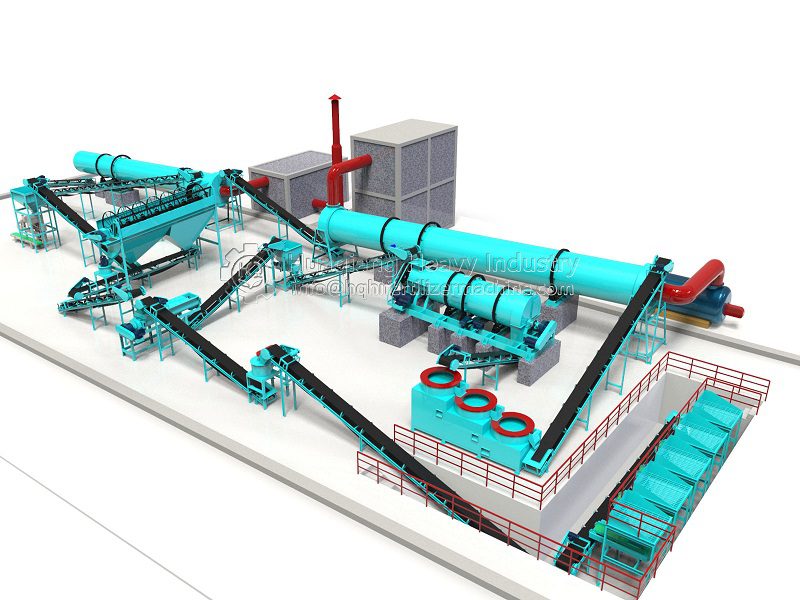
The proper selection of raw materials (livestock manure, straw, by-products) with appropriate C/N ratio (25-30:1) and fermentation control is the foundation for a successful bio-organic fertilizer production line for pig manure. After fermentation (temperature 55-65°C for 5-7 days, moisture 55%-65%), the mature material (dark brown, no odor, pH 6.0-8.0, GI>70%) is processed through organic fertilizer raw material processing equipment, such as a half-wet material crusher machine, to the ideal particle size. This prepared material is then ready for granulation. Within the organic fertilizer granulator series, options include a new type two in one organic fertilizer granulator (combining mixing and granulation) or a disc granulator for spherical granules. For a complete organic fertilizer disc granulation production line, the disc granulator is the core, producing round, aesthetically pleasing granules. Functional microorganisms (Bacillus subtilis, etc.) should be added after the material cools below 40°C, during the mixing or coating stage (0.1%-0.5% dosage), to avoid high-temperature kill. The organic fertilizer production equipment set includes crushers, mixers, granulators, and optional low-temperature dryers (<60°C) if needed. For bio-organic fertilizer, low-temperature drying or direct powdered product is recommended to preserve microbial activity. Proper raw material selection—avoiding antibiotic residues, adjusting C/N ratio, and controlling fermentation parameters—is essential. The key is to integrate these steps into a seamless bio-organic fertilizer production line for pig manure, ensuring high organic matter stability and high functional bacteria survival rates. Understanding the role of each piece of organic fertilizer production equipment is essential for producing high-quality bio-organic fertilizer.
The selection of raw materials and fermentation control in the production of bio-organic fertilizer directly determine the stability of organic matter and the survival rate of functional bacteria in the product. Only by controlling these two aspects can subsequent granulation and packaging be meaningful. It is recommended to conduct small-scale fermentation trials before formal production to understand the characteristics of local raw materials and the optimal ratio before scaling up to the production line.