
Higher Capacity Isn’t Always Better
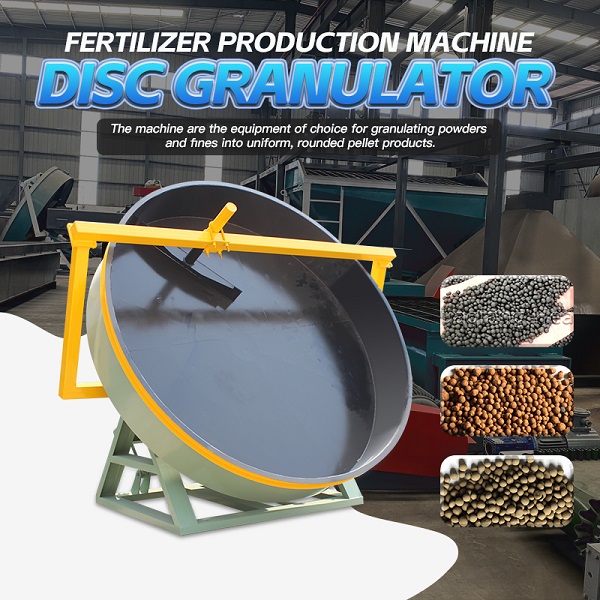
Disc granulators, due to their simple structure, smooth pellet formation, and low investment, have become a popular choice for small and medium-sized organic fertilizer and compound fertilizer plants. However, many users fall into a misconception when purchasing: focusing solely on the “tons per hour” figure and blindly pursuing high-capacity models. In fact, the selection of a disc granulator should comprehensively consider actual output needs, raw material characteristics, upstream and downstream equipment compatibility, and investment budget. Choosing too large a capacity will lead to idle equipment and wasted funds; choosing too small a capacity will become a bottleneck for the entire production line.
The True Meaning of Capacity
The nameplate capacity of a disc granulator is usually a range value, such as “1-3 tons per hour”. This range is flexible because actual output is influenced by multiple factors: the disc diameter and depth determine the material capacity; rotational speed and tilt angle affect the material residence time; the pelletizing properties of the raw material (fineness, moisture content, viscosity) directly affect the pelletizing speed and yield; and the operator’s control over the spray volume and feed rate also contributes to variations.
Generally, a disc granulator with a disc diameter of 1.2 meters produces approximately 0.5-1 ton per hour; 1.5 meters, 1-2 tons per hour; 1.8 meters, 2-3 tons per hour; 2.2 meters, 3-5 tons per hour; and over 2.5 meters, 5-8 tons per hour. These figures are achieved under conditions of good raw material pelletizing properties and proper operation.
Four-Step Method for Selecting the Right Model Based on Needs
Step 1: Calculate daily and annual output. Taking an annual production of 3000 tons of organic fertilizer as an example, assuming 250 working days per year and 10 hours per day, the hourly output only needs to be 1.2 tons. A 1.5-meter diameter model (1-2 tons per hour) is sufficient, with some margin but not excessive.
Second step: Consider upstream and downstream equipment matching. The capacity of the disc granulator should match the upstream crushing and mixing equipment and the downstream drying and screening equipment. If the upstream mixer can only provide 1 ton of material per batch, then even a 5-ton per hour granulator will not be efficient.
Third step: Assess the pelletizing properties of the raw materials. Fermented organic materials such as chicken manure and cow manure have high fiber content and generally poor pelletizing properties; the actual output may only be 60%-70% of the nameplate value. For these types of raw materials, a larger model should be selected.
Fourth step: Reserve room for expansion. If there are plans to expand production in the next two to three years, a slightly larger model can be selected, or a small machine can be purchased first as a start, and then another can be added as production increases, with two machines operating in parallel.
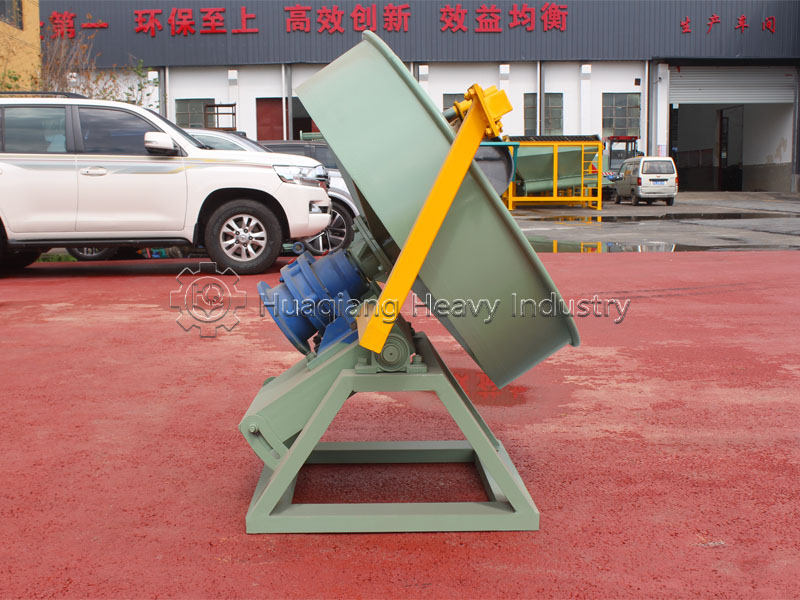
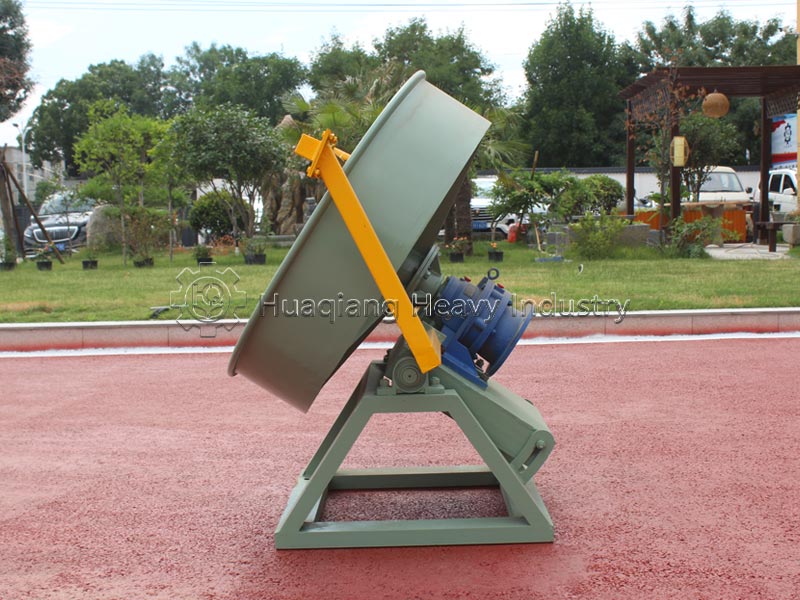
The correct selection of a disc granulator is a critical decision within the organic fertilizer granulator series. While a disc granulator is ideal for small to medium-scale organic fertilizer production, other technologies are available for different applications. For dry compaction, a fertilizer compactor (such as a double roller press granulator) achieves fertilizer granules compaction through high mechanical pressure, ideal for dry, moisture-sensitive materials. A rotary drum granulator (or drum granulator) is the workhorse of large-scale npk fertilizer production lines, using steam for wet agglomeration as part of the npk fertilizer manufacturing process. For very small-scale or specialty applications, a flat die pelleting machine provides a low-cost entry point. The key principle for disc granulator selection is “matching”—capacity must match actual output, raw material characteristics (organic materials often have poor pelletizing properties), and upstream/downstream equipment. Higher capacity isn’t always better; a 1.5-meter diameter disc granulator producing 1-2 t/h is sufficient for a 3000 t/year plant. The four-step selection method—calculating output, matching with other equipment, assessing raw materials, and reserving expansion space—is essential. Understanding the unique strengths of each technology in the organic fertilizer granulator series, from the disc granulator to the rotary drum granulator, is key to building a cost-effective and efficient production line.
The core principle of disc granulator selection is “matching”—matching your actual output, matching your raw materials, and matching your production line. Taking the time to figure out these costs is far more worthwhile than blindly pursuing large production capacity.