
In organic fertilizer production, disc granulation production lines have become a popular choice for small and medium-sized organic fertilizer plants and farm supporting projects due to their moderate investment, flexible operation, and perfectly round particles. Whether processing livestock and poultry manure, fermented straw, or producing organic-inorganic compound fertilizers, disc granulation can achieve stable particle quality with a simple process. This article analyzes the core equipment, technological advantages, and applicable scenarios of disc granulation production lines.
Core Components of a Disc Granulation Production Line
A standard organic fertilizer disc granulation production line comprises five core units: raw material pretreatment, batching and mixing, disc granulation, drying and cooling, and screening and packaging. Raw materials are processed to a fineness of less than 5mm by a semi-wet material crusher, then mixed evenly with auxiliary materials and microbial agents in a horizontal mixer, and finally conveyed to the disc granulator by a belt conveyor. After granulation, the wet granules are dried at a low temperature (≤60℃) in a rotary dryer, cooled, and then classified by a drum screen. Qualified granules (2-5mm) are quantitatively packaged by an automatic packaging machine, while fine powder is returned to the granulator for reprocessing.
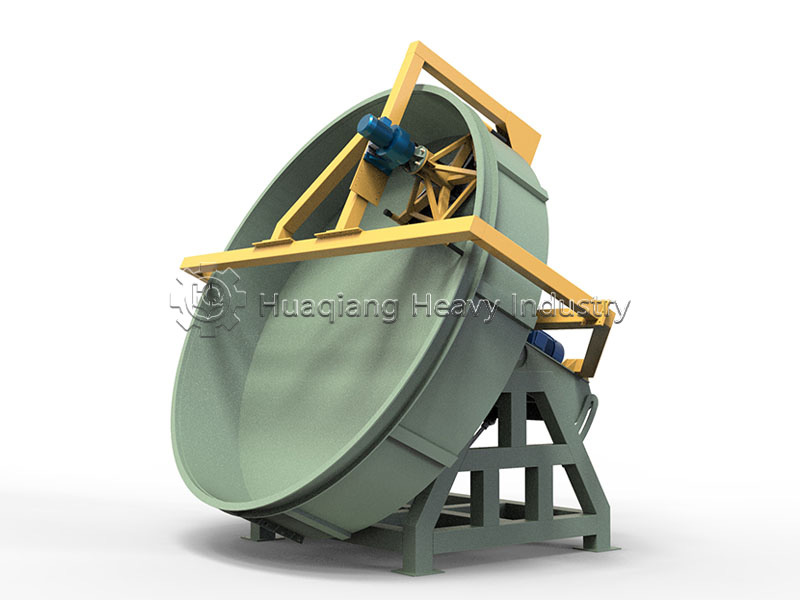
Technical Advantages of the Disc Granulator: The core of the disc granulator lies in the rotating granulation mechanism of the inclined disc. The material rotates within the disc, rolling in a circular motion under the combined action of gravity and centrifugal force. Atomizing nozzles evenly replenish water, wetting the powder surface. Small granules act as cores, continuously adsorbing surrounding powder and gradually growing into spheres. The disc inclination angle (35°-55°) and rotation speed (10-20 r/min) are both steplessly adjustable, allowing precise control of the particle size within the 1-5mm range.
Compared to other granulation methods, disc granulation has three major advantages: First, it has a low investment threshold. A disc granulator with a capacity of 2-3 tons per hour requires an investment of approximately US$30,000-80,000, only 1/3 to 1/2 the investment of a rotary drum granulation line. Second, it is flexible in operation; formula changes only require adjusting the tilt angle and rotation speed, and production can be completed within 10 minutes. Third, it produces high sphericity of the granules. The rolling process results in smooth, rounded granules with no sharp edges, leading to good market acceptance.
Applicable Raw Materials and Production Capacity Range: Disc granulation production lines are particularly suitable for processing fermented and decomposed organic materials, such as fermented chicken, cow, and pig manure, as well as straw, mushroom residue, and medicinal residue. The material moisture content needs to be controlled at 20%-30%, with a feel that allows it to “crumb when squeezed but crumble when dropped.” This process is also suitable for the production of organic-inorganic compound fertilizers, where inorganic nutrients such as urea, ammonium phosphate, and potassium salts can be added in proportion during the mixing stage. Production capacity ranges from 1-8 tons per hour, corresponding to an annual output of 3,000-25,000 tons, making it an ideal choice for small and medium-sized organic fertilizer plants.
Process Optimization and Quality Control: The key to granulation success lies in the matching of moisture content and rotation speed. Excessively wet materials tend to clump together at the bottom of the discs, while excessively dry materials result in low pellet formation. The atomizing spray system uses high-pressure nozzles to evenly cover the material surface, preventing localized over-wetting. The spiral guide plate design on the inner wall of the discs effectively prevents material stratification, ensuring uniform mixing of light and heavy materials. The output pellets have a moisture content of approximately 20%-25%. After low-temperature drying to below 15% and cooling to ambient temperature, the pellet compressive strength reaches 8-12N, meeting storage and transportation requirements.
.jpg)
At a palm oil processing plant in Southeast Asia, a disc granulation production line with an annual processing capacity of 15,000 tons of empty palm fruit bunches has been operating stably for many years. After fermentation, the raw materials are granulated using discs, producing round, odorless organic fertilizer pellets that significantly improve soil compaction problems when used in oil palm plantations.
In an agricultural demonstration project in Africa, a disc pelletizing production line was integrated with a small-scale farm. Cow manure was mixed with straw, fermented, and then pelletized. The product performed exceptionally well in local vegetable cultivation, with farmers reporting improved root systems and increased yields.
The organic fertilizer disc granulation production line is a key member of the organic fertilizer granulator series, representing a gentle approach to organic fertilizer production granulation. This wet agglomeration process contrasts with dry compaction methods. A fertilizer compactor (such as a double roller press granulator) achieves fertilizer granules compaction through high mechanical pressure, ideal for dry, moisture-sensitive materials. The rotary drum granulator is the workhorse of large-scale npk fertilizer production lines, using steam for wet agglomeration. For the npk fertilizer production process, the choice of granulator is strategic. The disc granulator is best suited for small to medium-scale organic fertilizer production, where its low investment, flexible operation, and high sphericity are major advantages. It excels at processing fermented organic materials with moisture content between 20%-30%. The key to its success is precise control of disc angle, rotation speed, and moisture addition. While the rotary drum granulator offers higher capacity for large-scale npk fertilizer production lines, the disc granulator remains the preferred choice for many organic fertilizer producers. Its ability to produce perfectly round, smooth granules makes it a favorite for markets that value product appearance. The disc granulation line, with its simple process and low investment, is a practical and profitable entry point into organic fertilizer production.
With its three main characteristics—low investment, simple operation, and stable quality—the disc pelletizing production line has become a practical choice for small- to medium-scale organic fertilizer production. Whether used in farm facilities or by professional organic fertilizer plants, this technology helps you efficiently transform waste into high-value granular fertilizer. Please provide your raw material list and production capacity requirements to obtain a customized disc pelletizing production line configuration plan.