
Bio-organic fertilizer has emerged as a high-value category in the fertilizer market in recent years. It organically combines organic matter, functional bacteria, and nutrients, offering multiple benefits such as soil improvement, disease suppression, and increased yield and quality. Compared to ordinary organic fertilizer, bio-organic fertilizer has more stringent requirements for production processes and equipment. This article details the complete process flow and key control points.
Core Components of Bio-Organic Fertilizer
The unique value of bio-organic fertilizer stems from the synergistic effect of its three main components. Organic matter serves as the carrier and nutrient source for functional bacteria, typically requiring a content of ≥40%. Raw materials include fully decomposed livestock and poultry manure and crop straw. Functional bacteria are the core active ingredient; common strains include Bacillus subtilis, Bacillus licheniformis, and phosphorus- and potassium-solubilizing bacteria, with an effective viable count of ≥0.2 billion/gram (some high-end products ≥200 million/gram). Nutrients, such as nitrogen, phosphorus, and potassium, are added in appropriate amounts according to crop needs. The scientific ratio of these three components determines the product’s functional characteristics and market positioning.
Detailed Process Flow Explained: The bio-organic fertilizer production line adopts a “heavy front, light back” process design—pre-treatment ensures full composting of organic matter, while post-treatment maximizes the protection of live bacteria. The first step is aerobic fermentation, using raw materials such as livestock and poultry manure and straw, which are fully fermented and composted by a turning machine to thoroughly kill pathogens and insect eggs. The second step is crushing and sieving, pulverizing the composted material to a fineness of 80-100 mesh for easy and uniform mixing later. The third step is mixing and batching, using an automatic batching system to accurately measure organic materials, inorganic nutrients, and functional bacteria to ensure a stable formula. The fourth step is gentle granulation, using a roller extrusion granulator or disc granulator to avoid damage to the bacteria at high temperatures. The fifth step is low-temperature drying, with the drying temperature strictly controlled below 60℃, using a segmented drying process to ensure the survival rate of live bacteria. The sixth step is cooling, reducing the granule temperature to room temperature. The seventh step is secondary bacterial addition (if necessary), adding heat-sensitive functional bacteria after cooling via powdering or spraying. The eighth step is screening and packaging. After removing substandard particles, the finished product is automatically weighed, packaged, and stored.
Key Process Control Points There are three core control points in the production of bio-organic fertilizer, which directly determine product quality. First is temperature protection—functional bacteria are extremely sensitive to high temperatures; their activity begins to decline above 60℃, and a large number die above 80℃. Therefore, cold pressing processes such as roller extrusion granulators should be used in the granulation stage, and low-temperature drying technology should be used in the drying stage, controlling the equipment discharge temperature below 50℃. Second is moisture content control—live bacteria are in a dormant state in a dry environment; excessive moisture content easily leads to mold and spoilage. The moisture content of the finished product should be controlled below 20% to ensure the survival of the bacteria while meeting storage and transportation requirements. Third is particle strength—particles that are too hard affect disintegration and the release of live bacteria, while particles that are too soft are easily broken and pulverized. By adjusting the type and amount of binder, the compressive strength of the particles is controlled between 6-12 Newtons, which meets both packaging and transportation requirements and allows for rapid disintegration in the soil.
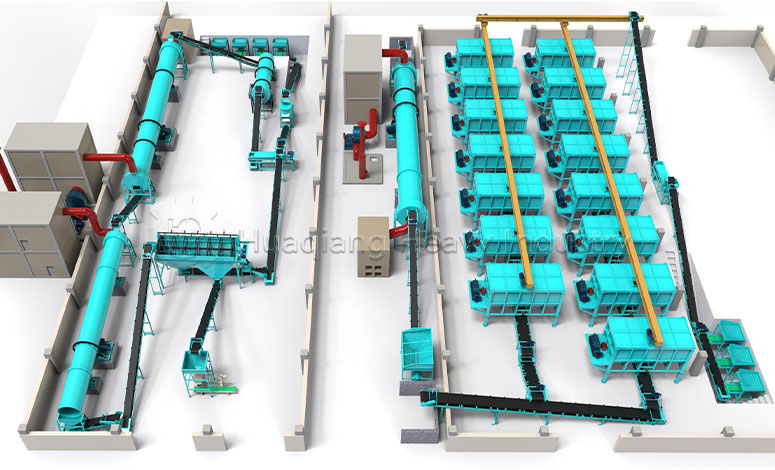
Recommended Equipment Configuration
Given the characteristics of bio-organic fertilizer, equipment selection should prioritize “mildness.” The fermentation section should utilize hydraulic or trough-type turning machines to ensure uniform and thorough composting. The crushing section should be equipped with a semi-wet material crusher, requiring higher fineness. The granulation section should ideally use a roller extrusion granulator—a dry process that requires no heating, causing zero damage to functional bacteria, making it particularly suitable for high-end bio-organic fertilizer production. For producing round granules, a disc granulator can be used, but strict control of material temperature is necessary. The drying section should employ a low-temperature rotary dryer, with hot air temperature controlled between 60-80℃ and equipped with a temperature interlock protection device for automatic shutdown in case of overheating. The cooling section should use a rotary cooler to reduce granule temperature to room temperature. An automatic batching system is crucial for ensuring formula stability, with a metering accuracy of ±0.5%. The entire line should be centrally controlled by PLC to minimize human intervention affecting product quality.
Core Advantages of Bio-Organic Fertilizer
Compared to ordinary organic fertilizer, the value of bio-organic fertilizer lies in three aspects. In terms of soil improvement, functional bacteria, after colonizing the soil, can decompose fixed nutrients, secrete plant growth hormones, and form a beneficial microbial barrier. Long-term application can significantly improve soil aggregate structure and alleviate continuous cropping obstacles. Regarding disease control, biocontrol bacteria such as Bacillus subtilis have significant antagonistic effects on soil-borne diseases (such as damping-off and root rot), reducing pesticide use. In terms of quality and yield improvement, the metabolites of functional bacteria can promote root development and improve fertilizer utilization. In high-value-added crops such as fruits, vegetables, tea, and medicinal herbs, yield increases can reach 10%-20%, and the quality of agricultural products (sweetness, taste, and appearance) is significantly improved.
The production of bio-organic fertilizer relies on a carefully selected set of organic fertilizer production equipment. The journey begins with the organic fertilizer fermentation process, which transforms raw waste into a stable, mature base. This material is then prepared using organic fertilizer raw material processing equipment, such as a half-wet material crusher machine, to achieve the ideal particle size. This prepared material is then ready for the granulation stage. Within the organic fertilizer granulator series, several options exist for a bio organic fertilizer production line. For producing high-quality, spherical granules, a complete organic fertilizer disc granulation production line is a classic choice, but careful temperature control is required. For operations seeking to preserve microbial viability, a new type two in one organic fertilizer granulator or a roller extrusion granulator (dry process) is often preferred as they generate no heat. The key to successful bio-organic fertilizer production is “gentle processing.” From the low-temperature drying (≤60°C) to the gentle granulation, every step must protect the functional bacteria. The integrated system of organic fertilizer production equipment must be designed with microbial protection as the primary goal. The result is a high-value product that offers not just nutrients, but soil improvement and disease suppression, commanding a premium in the market.
Although bio-organic fertilizers require more sophisticated processes and slightly larger equipment investments, their product premium and market competitiveness are far superior to ordinary organic fertilizers, making them an ideal direction for the transformation and upgrading of small and medium-sized fertilizer enterprises.