
In the production of organic-inorganic compound fertilizers, extrusion granulation, with its unique advantages of eliminating the need for drying, low energy consumption, and producing high-strength granules, is becoming the choice of more and more factories. Compared with traditional wet drum granulation, the extrusion process eliminates the steam conditioning and drying stages, reducing overall line energy consumption by 40%-60%, while avoiding the damage to organic matter and beneficial bacteria caused by high temperatures. This article will analyze the core equipment and process characteristics of extrusion granulation production lines.
Dry Extrusion: A Process Innovation in One-Step Forming
Extrusion granulation adopts the principle of “dry forming,” eliminating the need for added water or binders. Raw materials (moisture content ≤8%, fineness 80-120 mesh) are fed between two counter-rotating rollers via a forced feeding system. The roller surfaces are decorated with precisely engraved grooves, and under high pressure of 10-25 MPa, the material is compacted into flake or pillow-shaped granules. This process increases particle density by 1.5-3 times, achieving a compressive strength of 15-30N, far exceeding that of ordinary commercially available granules. From powder to finished product, no heat processing is required, truly achieving one-step forming from powder in, granulation out.
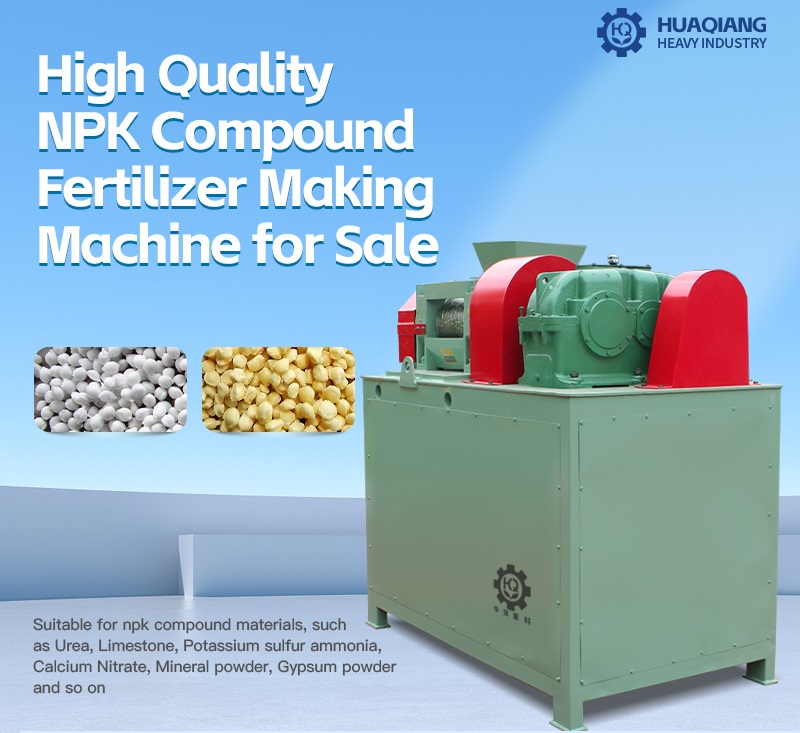
No drying, low energy consumption: Significantly reduced operating costs. The biggest cost advantage of the extrusion granulation production line is the elimination of drying. In traditional wet processes, the drying stage accounts for over 60% of the total energy consumption, while the extrusion process eliminates the need for dryers, hot air furnaces, and associated dust removal equipment. Electricity consumption per ton of product is only 8-12 kWh, saving over 60% in electricity costs compared to the rotary drum process. For a production line with an annual output of 30,000 tons, this translates to annual savings of 150,000-200,000 RMB in electricity costs alone. Simultaneously, the absence of a heat source simplifies environmental impact assessment approvals, meeting stricter environmental protection requirements.
Adaptable to over 20 raw materials, with flexible addition of trace elements. Extrusion granulation has a wide range of adaptability to raw materials, processing organic materials such as fermented livestock and poultry manure, straw powder, humic acid, peat, and lignite, as well as inorganic fertilizers such as urea, ammonium phosphate, potassium chloride, and ammonium sulfate, covering over 20 common fertilizer raw materials. More importantly, the extrusion process is ideal for adding trace elements—zinc, boron, iron, manganese, etc.—which can be added directly during the mixing process and evenly distributed within the granules through high-pressure compression, avoiding uneven coating later. This characteristic makes the extrusion production line an ideal platform for producing specialized fertilizers and compound fertilizers.
High granule hardness and resistance to breakage: Significant advantages in storage and transportation. Extrusion granulation produces flattened spherical or pillow-shaped granules with high density and hardness, achieving a compressive strength 2-3 times that of ordinary drum granules. During bagged storage, long-distance transportation, and mechanized spreading, the granule pulverization rate is extremely low, resulting in excellent customer feedback. Meanwhile, high-density granules have slow-release properties, extending the nutrient release cycle by 20%-30% compared to loose granules, thus improving fertilizer utilization.
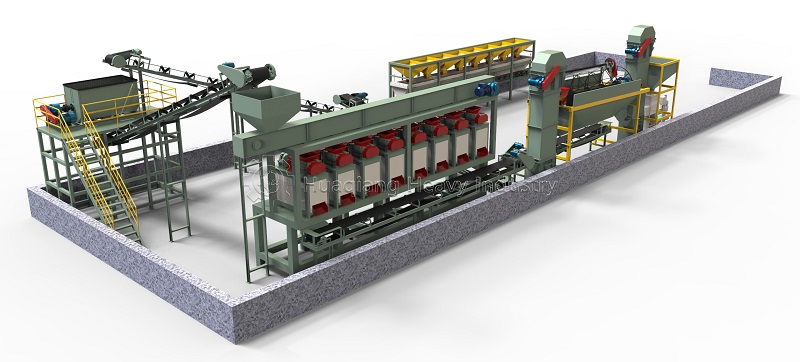
Suitable System Configuration for Organic + Inorganic Compound Fertilizers
A standard extrusion granulation production line includes: a chain crusher, a twin-shaft mixer, a roller extrusion granulator, a drum screen, and an automatic packaging machine. Auxiliary equipment includes a forced feeder, a return system, and a dust removal device. The entire line has a compact layout, occupying only 300-500 square meters (5 tons per hour capacity). From raw materials to finished products, it only requires five processes: “crushing-mixing-extrusion-screening-packaging,” making the process simple and easy to operate and maintain. For customers requiring round granules, a polishing machine can be added after screening to round the extruded granules.
From livestock manure to straw, from humic acid to NPK, extrusion granulation production lines, with their core strengths of dry forming, low energy consumption, and high-strength granules, have become the preferred solution for organic-inorganic compound fertilizer production. We welcome you to provide your raw material list and capacity requirements to obtain a customized extrusion process solution.
The extrusion granulation process represents a distinct branch of fertilizer production machine technology, centered on achieving efficient fertilizer granules compaction. As a fertilizer compactor, the double roller press granulator is the core of a roller press granulator production line, offering a dry, energy-efficient alternative to traditional methods. This contrasts with a rotary drum granulator, which relies on steam and wet agglomeration. For an npk fertilizer production line, the choice between these two technologies is a strategic decision. The rotary drum granulator is a proven workhorse for large-scale, continuous production of spherical granules. However, for producers focusing on organic-inorganic blends or seeking to minimize energy consumption and preserve heat-sensitive nutrients, the roller press granulator production line offers compelling advantages. This implementation of npk fertilizer production technology eliminates the need for drying, significantly reducing operating costs and plant footprint. The resulting high-density granules, with their exceptional strength, are ideal for blending and long-distance transport. The extrusion process is a key example of how fertilizer production machine technology is evolving to meet the demands for more efficient, sustainable, and versatile fertilizer manufacturing.