
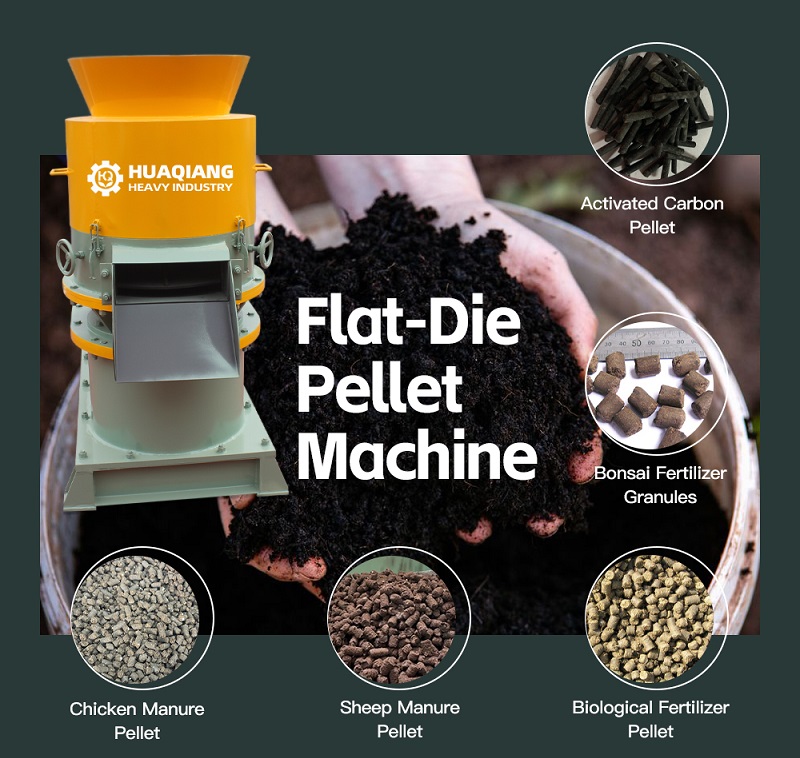
A Minimalist Solution for Small-to-Medium Scale Organic Fertilizer Granulation
In the field of organic fertilizer and biomass pellet production, the flat die pelleting machine, with its simple structure, convenient operation, and moderate investment, has become the first choice for many family farms, livestock farms, and small organic fertilizer plants. It can compress fermented livestock manure, straw powder, mushroom residue, and other materials into cylindrical pellets, which are convenient for storage and transportation and suitable for mechanized fertilization. This article analyzes the core structure, operation, maintenance, and applicable scenarios of the flat die pelleting machine.
Core Structure: Die, Pressure Rollers, Main Shaft
The main body of the flat die pelleting machine is a horizontally installed annular die (flat die), with multiple forming holes evenly distributed on the die plate. Two to three rotatable pressure rollers are installed above the die plate. During operation, the motor drives the pressure rollers to rotate via the main shaft. Material falls from the feed inlet into the die plate, is crushed by the pressure rollers into the die holes, and compacted into cylindrical strips. Finally, a cutter below the die plate cuts the material into pellets of the desired length. The diameter of the flat die holes determines the pellet diameter (commonly 2-8mm). The gap between the pressure rollers and the die plate must be maintained at 0.1-0.3mm; too small a gap accelerates wear, while too large a gap makes pelleting difficult.
Applicable Raw Materials: Manure, Straw, Biomass
The flat die pellet mill is particularly suitable for processing pure organic materials. Livestock and poultry manure (chicken manure, cow manure, sheep manure) needs to be fully fermented and decomposed, with a moisture content controlled at 12%-15%. Excessive moisture easily clogs the die holes, while excessive dryness results in loose pellets. Fiber materials such as straw, rice husks, and sawdust need to be crushed to a fineness of 2-5mm and can be pelletized separately or mixed with manure. In the biomass fuel sector, flat die pellet mills can compress sawdust, bamboo shavings, peanut shells, etc., into biomass pellets for clean energy replacement of coal. It’s important to note that flat die pellet mills are not suitable for materials with high hardness, high moisture content (>18%), or containing sand or gravel impurities.
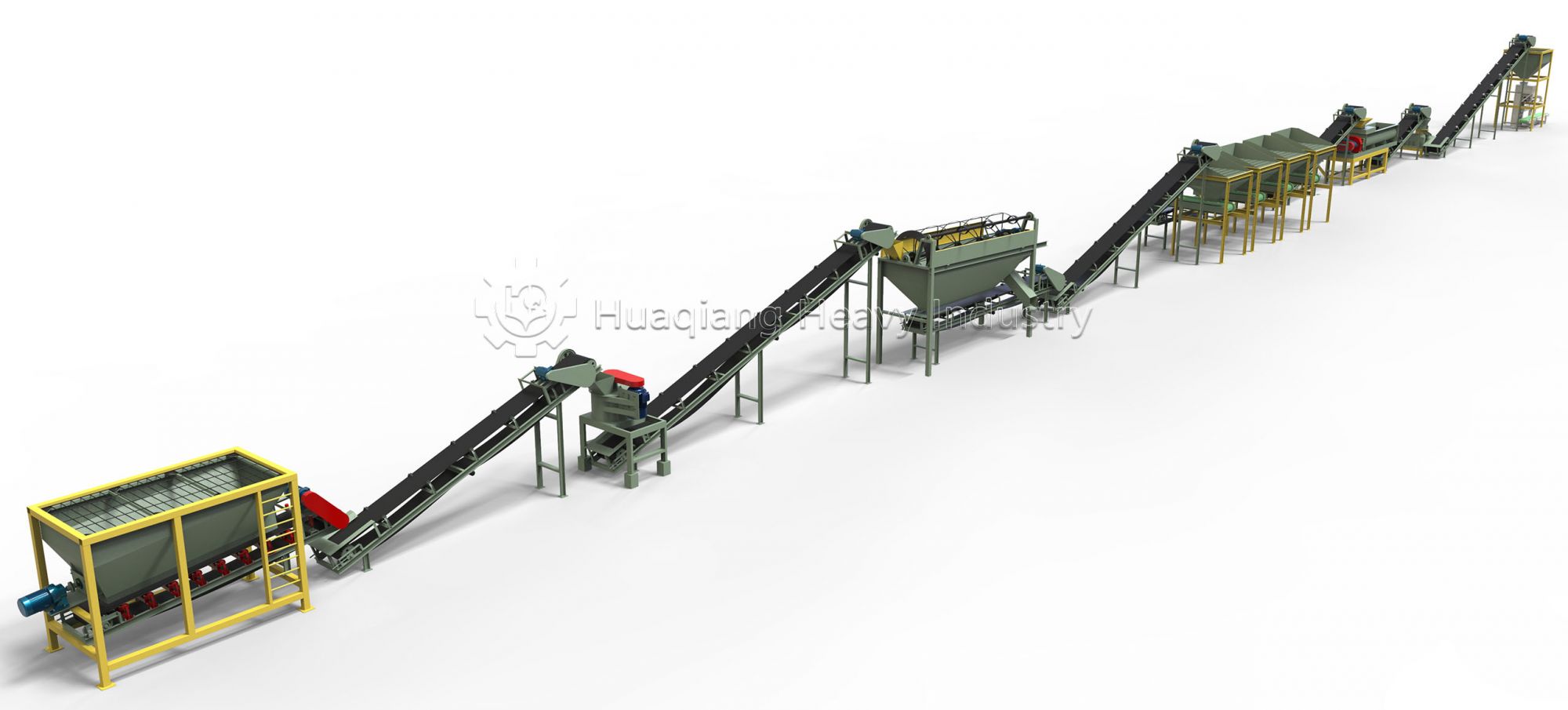
Operation and Maintenance: The die is a core wear part. Key operating points for flat die pellet mills include: checking the gap between the pressure roller and the die before starting the machine, running it unloaded for 2-3 minutes to confirm there are no abnormal noises; feeding should be even and continuous, avoiding sudden changes in quantity; before stopping the machine, feed oily material (such as oil residue or oily waste) to fill the die holes to prevent clogging the next time it starts. In daily maintenance, clean the residual material on the die surface each shift, and add grease to the pressure roller bearings every 100 hours. The die is a core wear part with a normal service life of approximately 600-800 hours. When the discharge speed decreases significantly, the pellets become loose, or obvious wear steps appear on the inner wall of the die hole, a new die is required. When replacing, the flat die and pressure roller should be replaced in pairs to ensure a matching gap. Preferred Solution for Farms and Small Factories
For family farms or small factories producing 500-3000 tons of organic fertilizer annually, the flat die pellet mill is the most cost-effective option. A single flat die pellet mill with a capacity of 0.5-2 tons per hour requires an investment of only US$10,000-30,000. With a matching crusher, mixer, and simple screening machine, the total investment for the entire production line does not exceed US$50,000, occupying only 100-200 square meters. The equipment is easy to operate; one person can complete the pelleting, screening, and packaging operations, making it ideal for start-up organic fertilizer projects.
From chicken manure to corn stalks, from mushroom residue to sawdust, the flat die pellet mill, with its simple and reliable mechanical structure, transforms waste into high-value granular products. It is an ideal starting point for small-scale organic fertilizer production and a practical tool for a circular economy on farms.
The flat die pelleting machine is a cornerstone of fertilizer production machine technology for small to medium-scale organic operations. It achieves fertilizer granules compaction through a simple, low-cost extrusion process, creating dense, cylindrical pellets ideal for farms. This contrasts with large-scale rotary drum granulators used in high-capacity npk fertilizer production lines, which rely on wet agglomeration for spherical granules. While a fertilizer compactor like a double roller press granulator offers high-pressure dry compaction for industrial NPK lines, the flat die pelleting machine remains the most accessible entry point for producers focused on pure organic materials. Its simple mechanism—forcing material through a die with rotating rollers—is reliable and easy to maintain, making it the ideal solution for family farms and small plants. For these users, the flat die pelleting machine is not just a piece of equipment; it is a practical tool for transforming on-farm waste into a valuable, marketable product, providing a direct path from waste management to income generation.